Streetwise Professor

September 10, 2021

If You Believe “The Worse, the Better” Joe Biden Is the President You’ve Been Waiting For

Filed under: CoronaCrisis,Economics,Politics,Regulation — cpirrong @ 6:35 pm

In my next-to-last post I said Joe Biden gave the worse speech by any president in my lifetime. In his relentless pursuit of perfection, Biden excelled himself and gave an even worse speech yesterday.

Afghanistan last week, COVID yesterday.

As with the Afghanistan speech, the COVID speech was wretched both in terms of atmospherics and substance. The speech dripped with condescension and disdain for large numbers of Americans, notably those who are not vaccinated. (Implicit in most attacks on the unvaccinated is that they are white MAGA Neanderthals: in fact, Biden’s and the Democrats’ most important constituency, low income blacks, are disproportionately represented: why aren’t Biden and his party tarred as racists?)

One line in particular was disgusting: “We’ve been patient, but our patience is wearing thin.” Our patience? Our patience? Who are you? Just who the fuck are you that your patience matters fuck all?

And who is this we/our? You royalty now Joe? Or are you speaking on behalf of those actually pulling the strings.

Biden made two main arguments: it’s hard to decide which is more idiotic and insulting.

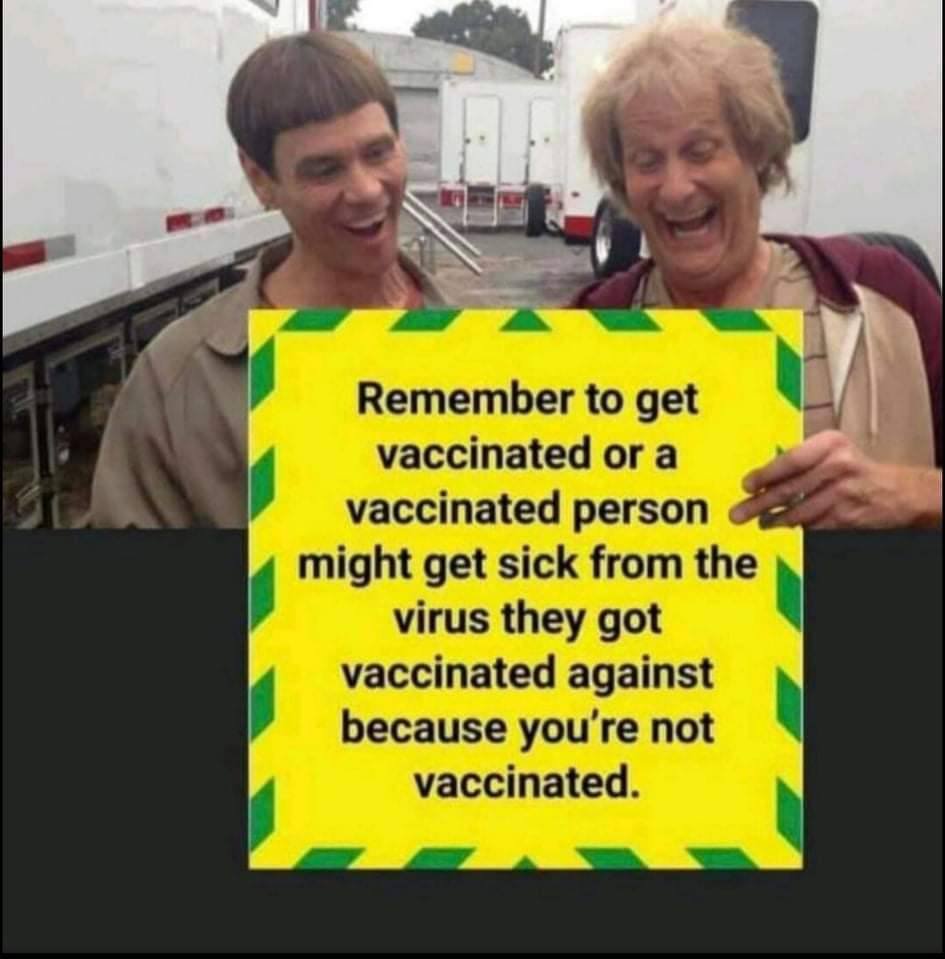
The first is that the unvaccinated pose a threat to the vaccinated: “We’re going to protect vaccinated workers from unvaccinated co-workers.”

Well, it looks like Dumb and Dumber have a new partner–Dumbest:
Image

The externality argument for mandated vaccinations has always been extremely weak. (Not surprisingly, alas, many economists have pushed this lazy argument because too many economists thinking about externalities is lazy in general.) As Coase pointed out long ago, it takes at least two to have an externality, and it is neither obvious nor relevant who “causes” it. The optimal assignment of a property right (and in the case of vaccination policy, what is involved is property rights in one’s person) depends on who is the least cost avoider.

With vaccines, if you are at high risk of COVID, and/or petrified of it, and/or think that the risk of vaccine is low, you can avoid COVID by becoming vaccinated yourself at lower cost than requiring someone who, for example, perceives the vaccine risk to be higher or incurs some other cost to take it (e.g., a religious objection) to be vaccinated. You can protect yourself at low cost: why force someone else to protect you at high cost?

So vaccinate yourself, and don’t force anyone else to do it–or demand the government force anyone else to do it.

But that argument is really moot now. Biden’s mandate is driven by the Delta variant, and Biden’s own CDC–you know, the experts whom we are supposed to defer to–says that vaccination doesn’t reduce the risk of transmission (though it does reduce the risk of serious illness–supposedly, although experience in Israel and elsewhere is casting doubt on that).

(One aside. This speech and the policies expressed were cast specifically as being a response to Delta. If you follow the data, you will see Delta has crested and is declining rapidly: even the NYT admits as such. As well as representing an unwarranted and unjust exercise of power, this policy is cynical: the administration will take credit for the decline in Delta even though it will have nothing to do with it.)

Further, there is the issue which has been raised by very esteemed (or at least once-esteemed) scientists (e.g., Nobel winner Luc Montagnier, but not just him) that the vaccines have spillover effects. Namely, it is hypothesized, and there is some evidence to support, that the vaccines accelerate mutation and in particular mutations that evade the vaccines. Meaning that there could be negative externality not from avoiding vaccination, but from being vaccinated.

As for the other costs that Biden mentions, namely the higher risk of serious illness and death among the unvaccinated, well that’s internalized: people willingly run the risk, and pay the consequences.

Biden’s other argument was “keeping our children safe and our schools open.” “For the children” is the last refuge of the modern (leftist) scoundrel. There is massive evidence–far more definitive than just about anything related to COVID–that children are at extremely low risk of either contracting or communicating COVID.

So hey, teacher, leave those kids alone.

It is particularly disgusting to see children used as Trojan horses for oppressive government policies given the massive harm that has been inflicted on them by governments at every level, most notably by denying them more than a year of education, as well as isolating them socially.

Not only are vaccine mandates a policy monstrosity, the means by which Biden is attempting to implement them are constitutionally monstrous. He has issued an executive order instructing OSHA to issue an emergency rule requiring all those firms employing more than 100 to make employment conditional on vaccination. As an emergency rule, this will be rushed through without the normal procedural safeguards the can sometimes prevent the promulgation of misguided and destructive policies. Moreover, doing this at the federal level by executive–something Biden said during the campaign he would not do and which his execrable flack Psaki said he could not do as recently as 23 July–runs roughshod over the Constitution and federalism.

But that was then. This is now. The even more execrable White House Chief of Staff, Ron Klain, called the OSHA gambit “the ultimate work-around.” Funny I remember the oath of office being about protecting and defending the Constitution, not “working around” it.

Why do we even have a Congress? That’s a serious question. Why do we have states? Another serious question.

Many parts of the country are strongly opposed to his. Many governors in states in those parts of the country have vowed to fight. To which Biden said: “If they will not help, if those governors won’t help us beat the pandemic, I’ll use my power as president to get them out of the way.”

What powers would those be? Just how, pray tell, can the president get governors “out of the way”? A drone strike? (You know, like the one that killed an Afghan who had helped Americans and his children?)

I’ve said before, and I will say it again: we are hurtling towards a constitutional crisis. Vaccine mandates are bad on the merits, and even worse when rammed down our throats while throwing constitutional and federal principles to the winds.

Not only has Biden given the worst presidential speeches of my lifetime, he has cemented his place as the worst, most destructive president of my lifetime, supplanting–by a mile–the loathsome LBJ. Alas, LBJ’s deficiencies became acute when he was entering the last year of his first full term (and his fifth year in office). Biden’s are manifest mere months after his inauguration. And his abject failings, and stubborn, disdainful refusal to brook any objection, are fanning the flames of civil conflict that could make the Vietnam protests look tame by comparison.

I have considered whether we have reached a stage where “the worse, the better” is a reasonable position. If one does indeed believe that, these are the times for you, and Joe Biden is the president for you.

September 8, 2021

The Fed and the Administration: Don’t Believe Your Lyin’ Eyes At the Supermarket Checkout

Filed under: Economics,History,Politics — cpirrong @ 7:15 pm

The basic lesson of Milton Friedman and Anna Schwartz’s majestic Monetary History of the United States is that most major economic disruptions in the history of the US have monetary origins. Since 1913, and the creation of the Federal Reserve, the Fed has been responsible for these monetary shocks. Which is why Friedman advocated rules over discretion, to reduce the degrees of freedom available to the Fed to fuck things up.

For this, with a few exceptions, Fed board members and chairs have hated Friedman, and attempted to devise alternative histories that blame others for Fed f-ups. Current Fed chair Jerome Powell has joined that crew of ankle biters.

The price level has spurt upwards lately, leading to fears of a resumption of 1970s-style inflation. Not wanting to admit that the current price level increases could be harbingers of true inflation (a sustained rate of increase of the price level), Powell is attempting to argue that these recent increases are due to idiosyncratic factors (e.g., COVID-related supply chain shocks) that will not persist. In an attempt to make this case, Powell has engaged in a revisionist history of 1970s inflation.

In a nutshell: it was your fault. Or your parents’/grandparents’ fault. So if inflation happens again, it’s your fault.

The basic story is this. There were supply shocks in the 1970s (e.g., OPEC) that caused price level increases. These caused people to believe (mistakenly, per Powell) that there was true inflation. These inflationary expectations were self-fulfilling: these expectations decreased the demand to hold nominal balances, which increased the velocity of money, which per the PY=MV equation led to an increasing price level, which confirmed inflationary expectations, which kept velocity high, etc., etc., etc.

There is a core of truth to this: expectations matter in inflation. But monetary growth matters too, and money growth in the 1970s was clearly as much of a driver of inflation as a shift in expectations. Indeed, the money growth was likely a cause of the shift in expectations.

Inflation peaked and subsided when the Fed (under Volcker) put the brakes to monetary growth.

Why does this ancient history matter? Because Powell is using it to justify standing pat on monetary policy despite the recent price spurts. Sort of like someone Powell should NOT want to imitate–Arthur Burns, who made very similar arguments in the 1970s. It was exactly the same don’t worry, be happy complacency that Powell expresses today that led Burns–and the country–down the path of inflationary perdition.

Indeed, Powell’s mistaken-inflationary-expectations argument is all the more reason to take aggressive action today to prevent a shift in inflationary expectations. If he really believes we’re all idiots who will confuse one-time price level shocks with true inflation, he should take aggressive action to show credibly that the Fed will not let inflation take hold. Using it to rationalize inaction which will likely exacerbate a shift in expectations is frankly idiotic.

And also like the 1970s, we are seeing a Democratic administration attempt to rationalize and blame. Case in point, Director of the National Economic Council Brian Deese. This oh-so-typical DC cockroach (who scuttled to Black Rock after the end of the Obama administration only to scuttle back to Washington with the ascension of a Democratic administration) was at pains to educate you idiots that what you are experiencing at the grocery story is a figment of your imagination, except when you pass the meat counter:

https://twitter.com/Breaking911/status/1435679846307405830?s=20

So I guess vegans should be happy!

This is transparently bullshit on many levels.

First, Deese is literally cherry picking by focusing on fruits and vegetables.

Second, if you look at other ag prices–notably corn, soybeans, and wheat–they have spiked in the last year (although they peaked in the summer and have turned down slightly). The increase in food prices is not limited to meat and poultry.

Here’s corn, for example:

Third, even looking only at meat and poultry Deese’s economics are idiotic and indeed represents another acid flashback to the 1970s.

For one thing, the consolidation in the meat sector occurred years ago, and cannot explain the increase in prices now. Furthermore, firms with market power raise prices above the competitive level, but that is different from causing an upward trend in prices (which is what inflation is). In attempts to deny the true cause of inflation in the 1970s, it was common for liberal politicians and liberal economists to blame “monopolies”: again, this is transparent bushwa, because although monopolies can raise price levels that’s different than causing an increase in the rate of change in the price level.

Indeed, ceteris paribus greater consolidation in the meat sector would tend to reduce input costs (e.g., corn and soy prices): greater monopsony power tends to decrease not increase input prices. That has obviously not happened in the last year. As noted above, corn, soy, and wheat prices have all spurted.

So there’s something else driving food price increases. Deese’s attempt to explain away what your lyin’ eyes see when checking out at the grocery store is pathetically and obviously wrong.

There may be a reason why this is a one time shock rather than a true inflationary trend. But Deese doesn’t provide any such reason, and his risible attempt to provide one seriously undermines his credibility.

And that ultimately is the problem. In the 1970s, the Fed’s and the Carter administration’s attempts to cast blame for price level increases undermined their credibility and contributed to the expectations spiral that Powell laments today. The 70s flashback of just such denial we are experiencing before our very eyes is the strongest indicator that real inflation will return. And with a vengeance, given the far weaker fiscal position of the US government (cf. the fiscal theory of the price level).

September 6, 2021

Joe Biden’s Speech: He Wanted to Depart Afghanistan In the Worst Way, and He Succeeded!

Filed under: Uncategorized — cpirrong @ 7:21 pm

Last Tuesday Joe Biden delivered the worst speech I have heard from any president going back to the mid-1970s, including Jimmy Carter’s “malaise” speech (in which he did not actually use that word, by the way). It was horrible both in terms of the delivery and the content.

In terms of delivery, Ranty Joe appeared in lieu of his alter ego Sleepy Joe. He shouted out his remarks, shrilly and defensively.

Note to Joe: saying something louder and more shrilly does not bolster your case. To the contrary. It makes it clear that you have no case to make.

Biden clearly came off as an extreme narcissist enraged by criticism of his conduct in Afghanistan. He could not acknowledge that the criticism he has received over Afghanistan had the slightest justification–that would be too much for his fragile narcissistic ego to handle. So he responded with rage and bitterness. He bristled with defiance, not against American enemies (a la say Churchill in 1940), but against Americans he deems to be his enemies because they dare question his judgment.

Very revealing.

The speech only accentuated the shock of many at Biden’s recent behavior, most notably at the arrival of 13 dead Americans at Dover, and his meeting with the parents of the dead. At the ceremony he acted disrespectfully (checking his watch repeatedly) and–wait for it–narcissistically by going on and on AGAIN about his dead son Beau, who has nothing in common with combat Marines shredded by a suicide bomber in Afghanistan except for the fact he is dead. Biden’s narcissistic ego was also evidently incensed at the anger directed towards him by the bereaved parents, in one case rolling his eyes at a mother of a fallen Marine and angrily saying over his shoulder as a Parthian shot at her that he understood her loss in response to her claim to the contrary.

It’s not about you, Joe. The fact that you can’t believe anything isn’t about you speaks volumes.

Amazingly many are astounded that Biden is not an empathetic healer in these trying times, as they assured us he would be in contrast to the boor Trump. Just what planet these people inhabit is unknown to me. Joe Biden has always–always–been a narcissistic, arrogant, asshole. Believe me: I’ve witnessed this for about 35 years. Anyone who thought otherwise is delusional.

And as I always remind my children, mark well my faults–they will become more pronounced as I age, so prepare to deal with them. This is true for most everyone: one’s least appealing traits almost always become more accentuated with age. Joe Biden is living (supposedly) proof of this: he is becoming a more narcissistic, arrogant asshole by the day. Moreover, his panic at the realization that he is in over his head is causing him to double down on obnoxiousness and rage.

That is, the problems with his obvious mental and physical decline are not that he’s “lost a step.” It’s that they have made his more repulsive traits (which are legion) more pronounced. He’s added a step to his arrogant repulsiveness.

One more point about affect. The extreme variance between Sleepy Joe (literally at times, as with his nap while meeting with the Israeli Prime Minister) and Ranty Joe is striking. This could again be symptomatic of senescence. But it also strikes me that it could be chemically induced, or exaggerated. Do they juice up Joe before they let him give a speech of such importance? It’s not the first time he’s appeared cranked during a speech in decided contrast to his dazed and confused mumbling during other public appearances.

Insofar as “substance” is concerned, the speech was an incoherent farrago. Getting out of Afghanistan was the right thing to do. But that’s not the point–the issue is how it was done, which Biden ignored. Biden wanted to get out of Afghanistan in the worst way–and he succeeded.

Bizarrely, moreover, Biden portrayed the exit as a great success. I am reminded of Pyrrhus of Epirus: “One more such victory and Pyrrhus is undone.” One more such success like Afghanistan and America is undone.

Moreover, even though Trump also said that getting out was the proper course, he didn’t give Trump props. Instead, per Biden, Trump caused the fiasco we have witnessed by tying his hands with a May 1 exit deadline. Except Trump obviously didn’t, because Biden moved the exit to 9/11 (swift move, dude), and then back to 8/31. This was not a date written in stone. And if Trump is so horrible–as Biden repeatedly has said–why would he feel bound to follow his plans? He hasn’t on anything else.

This is gaslighting on an epic scale. Every sentient being (I understand Biden may fail to qualify) recognizes this for the catastrophe it is. But Biden insists it is a great, great triumph. Who you gonna believe? Joe or your lyin’ eyes? Joe insists that you believe Joe.

Spare me more such successes. I can’t handle them.

We are learning more about the events that led up to the fiasco. Most notably, the Afghan president, Ghani, begged Biden for continued air support. Biden promised it–if Ghani could provide a plan, as if Ghani (rather than the US military on which his government and army were utterly reliant) was independently capable of conceiving such a thing. No air support was forthcoming. The inevitable happened.

Moreover, Gaslighter Joe instructed Ghani to gaslight the world, and claim that his army was succeeding when it clearly was not. Perception, not reality, was Biden’s preeminent concern.

This is dereliction of duty of the most egregious sort. A transparently political calculation to buy time and to distance himself from the impending catastrophe. In the end he did not, but the whole sequence of events reveals that Biden had only two objectives: to get out, and not to be blamed for an ultimate Taliban triumph.

Well, you’re batting 500, Joe.

Moreover, although Biden claims that the decision to abandon Bagram was made by the military, and that he merely acceded to it, it is clear that they made this decision due to a constraint that he imposed. Namely, a limit on the number of military personnel in Afghanistan to 650 or so. It was impossible to hold Bagram, the embassy, and the Kabul airport with such a paltry force. So Bagram went, and we were reliant on an utterly indefensible exit point.

This is on Biden, and his crew of idiots–namely the execrable NSC chair Jake Sullivan and Secretary of State Stinkin’ Blinken–and no one else.

In a parliamentary system, Biden and his crew (including latest milk carton “have you seen me?” person Kamala Harris) would have been removed through a vote of no confidence, and a snap election. But under the US system, which provides stability and continuity often lacking in parliamentary ones, we are cursed with them for at least another 40 months. (Life is all about trade-offs.)

If the catastrophes continue–and they well might, both geopolitical and economic–the prospect of continued misrule by a senile narcissist and idiot and assorted other throne sniffing dim bulbs will be unsustainable. In that event, there will be a constitutional crisis. How that will be resolved is unknown, but almost certain to be ugly, divisive, and destructive.

These are the fruits of 2020.

September 4, 2021

Where Are You Now, Bowe Bergdahl?

Filed under: History,Military,Politics — cpirrong @ 6:54 pm

Bowe has been the shy and retiring type since his exchange for five Taliban leaders seven years ago. So where’s Bowe?: Bowe knows! but not me. Said Taliban have been anything but retiring, however. When they were released Obama said they would never return to the battlefield again: TRUE! There was no battle to speak of in Afghanistan, but these guys sure enough showed up for the victory parade–as part of the Taliban leadership.

I questioned at the time trading multiple Taliban leaders for one American loser/deserter. The exchange rate comes to mind given that the Taliban now have their hands on many Americans who did not desert, but were abandoned by the US. Do you seriously think the Taliban–or even less savory elements in Afghanistan–will not extract an even higher price for them?

This thought is intensified by observation of a brisk and strange traffic in recent days. If you’ve followed flight tracking services, you may have noticed many unidentified Boeing 767 flights between various US-related origins (e.g., DC, Rammstein) and Sofia, Bulgaria, and Sofia, Bulgaria and Doha, Qatar. That is, flights without call signs or aircraft IDs. Qatar, moreover, is facilitating the reopening of the Kabul airport. Connect the dots.

What is on those flights? Guns? Money? Not likely lawyers (too bad!), but perhaps human cargo approved by lawyers? Apparently just as United hubs out of Houston, the CIA runs a hub out of Sofia. Why? For what purpose?

Afghanistan’s current overlords have substantial leverage over the US. No doubt they are exploiting it to the hilt. If we gave up so much for Bowe Bergdahl, consider what we would–and likely have–given up for Taliban forbearance during our withdrawal, and will give up for continued forbearance and future human exchanges.

Once upon a time “millions [update to ‘trillions’] for defense, not one cent for tribute” was an American battle cry. Once upon a time. No more. We are almost certainly paying massive tribute to entities far more sinister than the Bey of Algiers or the revolutionary government of France. In secret–secret from the citizens of the US, that is.

The humiliation continues and will continue.

August 20, 2021

Embrace the Suck

Filed under: History,Military,Politics — cpirrong @ 12:46 pm

Apparently the Biden administration is betting that the American people will indeed embrace it:

President Joe Biden is brushing off criticism of his administration’s chaotic Afghanistan withdrawal because he and his aides believe the political fallout at home will be limited, according to White House allies and administration officials.

Biden and his top aides argue they are managing an evacuation mission as well as could be expected given the faster-than-anticipated takeover of the country by Taliban insurgents, and are seeking to draw attention back to the choice to get U.S. troops out of the country.

The strategy is based on internal and public polling that shows the Afghanistan withdrawal had been by far the most popular decision Biden has made, even though the issue was not central for most voters.

The condescension here is palpable: Howdy Doody Biden and his various Charlie McCarthys believe that you are too stupid to be able to distinguish between a reasonable decision to exit and a catastrophically bundled way of doing it, or too apathetic to care.

This is so Soviet. Pretty much the same PR strategy the Soviets employed during Chernobyl and other assorted disasters: lie, deny, suppress, and depend on an apathetic populace to acquiesce meekly to the barrage of lies.

Speaking of the Soviets, during a “press conference” today, Biden did a great late-70s Brezhnev impersonation. He needs to put on some weight to give the full effect, but in terms of senescent befuddlement and denial of reality, he’s got it down pat. Among his most pathetic denials: no American is having problems getting to HKIA. Apparently their Uber apps are working great! He also blew off reports that diplomats on the ground had sent warnings about an impending disaster. His reply: Hey, I get cables all the time. I went with the consensus view. The consensus isn’t always wrong, but it usually is, especially in bureaucracies built on groupthink and ass kissing.

We can also expect to see a ramping up of Soviet-like distraction operations. Most notably: look for a barrage of COVID hysteria–directed at Republican governors in particular–and a focus on various domestic issues, notably voting legislation and massive stimulus bills (aka turning the US into an economic Afghanistan, except that we won’t grow our own opium.)

America’s Back, Baby!

Filed under: History,Military,Politics — cpirrong @ 12:12 pm

Those of you not in a memory care facility (so this perhaps does not apply to Joe Biden) remember the hysteria over Trump’s treatment of Nato. Yes, Trump rhetorically bashed Nato nations repeatedly for their utter failure to live up to their commitments on defense spending, and their perpetual free riding on the US. Yeah–I’m looking at you, Germany. How are those broomsticks working? But even though he spoke truth, truth was apparently undiplomatic. And we can’t have that! So one of the “elite’s” key briefs against Trump was his disrespect for our allies: Biden, they assured us, would treat them with respect and that would advance our collective interests.

When Biden won, he went about preening that “America is back” and that he would restore the alliances Trump had allegedly ruptured. The Europeans panted for a Biden presidency, and rejoiced at its arrival.

How’s that working out for you?

When shit got real and the chips were down, Biden totally shtupped Nato allies, whom you might know have suffered over 1,100 KIA in Afghanistan over the years (about 1/2 of US military personnel losses).

He failed to inform Nato allies what he was doing. In particular, the UK–the US’s most reliable and longstanding ally–was completely left out of the loop. When UK PM Boris Johnson frantically attempted to reach Biden, Joe didn’t answer the phone. Maybe he was washing his hair (plugs).

Even now, when coordination on the ground with allies in Afghanistan is paramount, there is precious little of it.

Joe decided to bug out–and not tell anybody about it, most notably the allies that he had so sanctimoniously claimed to have rescued from the clutches of the demon Trump.

How’s that for respect?

Deeds, not words, matter. A western elite that clutched pearls and collapsed on fainting couches over mean tweets that happened to drop truth bombs got exactly what it asked for. A man who mouthed meaningless pieties and cut and ran and left the elite in the lurch when it mattered.

The ranks of the soi disant elite is a target rich environment, but a few stand out. One is alleged conservative Bill Kristol. Search Twitter “@BillKristol trump nato” and you will find numerous tweets by this fat tub of goo armchair warrior excoriating Trump for being a meanie to Nato. This is my favorite:

Chaotically. Oh the irony is too much. You had no idea about what true chaos is, you neocon (emphasis on the “con”) knob. We’re seeing it now–because we got what you and so many of your “elite” ilk begged for.

The elite sowed the wind with their hysteria over Trump’s bumptiousness with American allies. They are reaping the whirlwind with their boy Biden’s utter betrayal of selfsame allies.

Actually, all of us are reaping the whirlwind–including those (unlike Bill Kristol et al) who realized that Biden was an incompetent and amoral windbag who would wreak havoc, like some evil version of Mr. Magoo.

August 18, 2021

Kabul on the Potomac

Filed under: History,Military,Politics — cpirrong @ 6:25 pm

Early this afternoon I tweeted that if I could do Photoshop I’d do a have-you-seen-me? milk carton with Lloyd Austin’s picture on it. Shortly thereafter, lo and behold, he and his sidekick General Mark Milley emerged for a press conference. Punxsutawney Lloyd should have stayed in his den.

His deer-in-the-headlights performance hardly inspired confidence. To paraphrase: “the Taliban have us by the balls and my plan is to hope they don’t squeeze too hard.” He flatly admitted that the US does not have the ability to bring Americans to the airport from Kabul and environs: their ability to get there is dependent on the goodwill of the Taliban. (“Goodwill of the Taliban.” That’s a phrase I never imagined writing non-ironically.) The State Department is advising said civilians to “make their way to Kabul Airport.” Great! Thanks! Well unless they’re in a convoy led by Mad Max good luck with that.

If anything, Milley was worse. He was mainly interested in defending himself, but every explanation/excuse only condemned him all the more. There were several appalling moments, but this was probably the worst:

Napoleon said that “In war, the moral is to the physical as ten to one.” Will and leadership ARE capability/capacity. Evaluating those should have been Milley’s primary focus. The best equipped force is worthless if morale is low and leadership is poor and lacks the will to fight (cf. the collapse of the Iraqi Army before ISIS–so it’s not as if this should not have been in Milley’s mind). To think that counting noses and rifles and vehicles is the key to evaluating combat capability is beyond amateurish. And it is not as if the morale and leadership problems are news. The Afghanistan Papers make it crystal clear that the problems are of longstanding, and were well known.

This is a confession of utter incompetence. He made other confessions, but this was the worst.

The saddest thing is that he clearly doesn’t realize that he confessed to all the world his abject incapacity for command. The fact that this man has not resigned staggers the imagination. Same goes for Austin. Same goes for Biden.

Honor is dead.

The immediate problem is that the US perimeter is, well, the perimeter of the airport. Which is in an urban area making it impossible to protect with airstrikes. Further, all of the Americans looking to get out of Afghanistan are outside the perimeter, and the Taliban controls every inch of ground they need to cover to get to the airport.

Any attempt to expand the perimeter would lead to a fight in which the enemy has all the advantages. Numbers. Fighting the US in urban terrain where the US cannot rely on armor and airpower as it did in say Fallujah or Mosul. A perimeter so small that relatively modest weapons (e.g., mortars) can reach everything within it–which would basically put a stop to air operations while the fight is ongoing.

Not to mention that the Taliban have thousands of potential hostages. So even if we dared the odds the objective of saving Americans would be compromised, not advanced.

Today questions were raised to the pathetic duo regarding the evacuation of the Bagram Airbase. It is more defensible, not being in urban terrain. So a much larger perimeter could be defended by fires, mainly from over-the-horizon via B52/B2/B1/AC130 airstrikes (and even carrier air a la 2001/2002), but also from Apaches at Bagram itself. It has two runways, not one.

Could Bagram be retaken, Milley was asked. “Great question!” he said. Then he weaseled and replied that he was not going to comment on “branches and sequels off our current operation.” That kind of argle bargle is exactly why the American military was ridiculed and disrespected in Vietnam.

Bagram is in Taliban hands (having been gifted to them some weeks ago). It could not be retaken without a major fight . . . and again, the Taliban have thousands of potential hostages.

It’s worth noting that the airbase was abandoned at the recommendation of CENTCOM commander Kenneth McKenzie, and Milley approved the decision. The “logic” was that Kabul International and Bagram were equally vulnerable (probably not true, but whatever), but that only one had to be chosen because the troops committed were limited to 600-700:

In other words, the mission was sized to fit the (pitiful) force allotted, rather than sizing the force to meet the mission.

(I also suspect this explanation is a lie: no doubt choosing KIA was done in deference to Afghan political sensitivities.)

But even the question of Bagram vs. KIA doesn’t get to the heart of the issue. The US should have been gathering its citizens and moving them out or at least staging them to a place they could be defended before moving them out. Like I said yesterday: move the soft stuff out first. It didn’t happen.

And this is where we are as a result.

I predict that the Taliban will magnanimously allow a large fraction of the Americans, other foreigners, and even some Afghans to leave, thereby achieving propaganda victories. But they will retain many, many hostages. Hell, the US doesn’t even know–within +/- 5000–how many Americans are in Afghanistan. So how would we even know if the Taliban have hostages, or how many?

So the current situation is like Mogadishu plus Benghazi multiplied many times over, plus Iran 1979, also likely multiplied many times over. With hostage takers that make the mullahs and their henchmen look placid and sane by comparison.

In other words, Kabul 2021 is a concatenation of America’s biggest military disasters of the past 42 years, times a large number.

So what is this going to be called? Operation Shitshow? Operation Anklegrab? Operation Clusterfuck?

Whatever it’s called, it is a debacle. And one that could have been prevented by better leadership. No, not in Afghanistan–in DC (or should I call it Kabul on the Potomac?).

August 16, 2021

Joe Biden’s Mendacious Defense of the Indefensible

Filed under: History,Military,Politics — cpirrong @ 6:43 pm

This afternoon Joe Biden delivered an angry, bitter, and defensive speech in an attempt to quell the uproar over the fiasco in Afghanistan. It was a pathetic attempt at misdirection–rhetorical three card monte by a man with slow hands, therefore fooling no one who does not want to be fooled.

The bulk of the speech was a strident defense of his decision to withdraw. Ironically, I agree with many of the points he raised: indeed, I raised them in earlier posts. Further ironically, I am sure that Donald Trump would have delivered the same speech to justify a withdrawal. Imitation is the sincerest form of flattery.

But that’s not the point right now. The issue isn’t whether withdrawal is wise: it is whether the handling of the withdrawal was executed with any competence at all, or was instead a historical debacle with few parallels in American history. On this fundamental question, Biden had little to say–and what he did say stood in stark contrast with what he said a little more than a month ago.

Biden heaped blame on the Afghan army and government. And there is much blame to heap–again, I agree with his points. But the harder he pushes that argument the more he demonstrates the cataclysmic failure in planning.

The defects Biden highlighted were common knowledge. For years. Meaning that any planning to withdraw had to take into account the manifest deficiencies in the Afghan army and government.

But if anything, the reverse was true. The WSJ reports that the American military told the Afghan president that the dispersion of his forces throughout Afghanistan in penny packets made them extremely vulnerable, but that Ghani said it would be “political suicide” to withdraw from isolated areas and concentrate. So he decided to commit military suicide instead–and the US conceded.

Further, the US eliminated all air support for the Afghans, and withdrew US maintenance personnel for Afghan aircraft. This was a recipe for catastrophe. Patton once wrote in his diary: “[French general] de Langres said the poorer the infantry is the more artillery it needs.” Well, (a) the Afghan infantry was about as poor as one could imagine, and (b) airpower is effectively artillery. So there should be no surprise that isolated and dispersed Afghan units crumbled when the US yanked the airpower crutch it so desperately needed. (Eerily reminiscent of 1975 Vietnam, by the way.)

So not only did the withdrawal “plan” fail to account adequately for the well-known deficiencies in the Afghan army and ameliorate them–it exacerbated them.

Moreover, according to the NYT, Biden was on notice that the Afghan army would collapse:

In late March, Mr. Austin and General Milley made a last-ditch effort with the president by forecasting dire outcomes in which the Afghan military folded in an aggressive advance by the Taliban. They drew comparisons to how the Iraqi military was overrun by the Islamic State in 2014 after American combat troops left Iraq, prompting Mr. Obama to send American forces back.

“We’ve seen this movie before,” Mr. Austin told Mr. Biden, according to officials with knowledge of the meetings.

Withdrawal in the face of an aggressive enemy is one of the hardest military tasks, but the basic steps are clear. Get out the soft stuff first. Concentrate around decisive points. Defend those points with fires while troops exit.

The approach implemented violated all these principles. The soft stuff–notably upwards of 10,000 American civilians, not to mention those of other nations–remained in place while the situation went to hell in a handbasket. Which is a major reason for the chaos at the Kabul airport.

Biden alluded to this in his speech, when he said that the Afghan government opposed the withdrawal of civilians because it would send a bad signal. That is understandable. It certainly would have been a sign of no confidence in the Afghan government. But we had no confidence in the Afghan government–Biden said as much. So deal with the reality and do what is necessary when you can’t rely on the locals. Get out the civilians while the getting is good.

Besides, evacuation of civilians would not have told the Taliban anything that they didn’t know–that the Afghan government and army were teetering on the brink. Would the Taliban have acted any differently if civilians had been evacuated? Ha!

As for concentration, as noted above the Afghan forces remained dispersed, vulnerable to being picked off unit by unit–as they were. And realizing that they were isolated and unsupported, decided that discretion was the better part of valor and either ran or surrendered. The military planning by the US should have attempted to counterbalance that, and further, it was another reason to accelerate removal of civilians.

As for firepower, again as noted, the US deliberately withheld that even though that has long been the American comparative advantage and that our military knew that the Afghans were desperately dependent on it.

Withdrawal before the enemy requires exquisite sequencing, but the US “plan,” such as it apparently was, had its sequencing completely out of whack, in large part because of deference to and undercutting of a government that Biden excoriated today for its incompetence and unreliability.

Biden’s speech also proved his mendacity, and that of Milley and Austin. As I posted yesterday, on 8 July Biden gave a stirring defense of the Afghan army and concluded that there was no way it would fold before the Taliban. Then, Biden said that this would not happen because of the army’s numbers and equipment: today he said that it happened despite its numbers and equipment. But Milley and Austin supposedly (per NYT) told Biden this would happen. Nonetheless, he adamantly opposed any changes to his plans.

In other words, he shamelessly lied a month ago about the reliability of the Afghan army, and lied today when he said that the collapse of that army came as a shock.

Milley is no better. He also stated categorically in public that the Afghan army would not fold–but this was not what he told the president. He should not have lied in public, and if he felt compelled to do so he should have resigned.

As for Austin–who knows? He’s like Major Major Major from Catch 22. Is he on vacation with Jen Psaki? Searching for extremists and vetting CRT training materials? Got me. He responded to an emailed question about whether he would resign by saying no. Other than that, he’s been personus not aroundus.

In sum, all of the factors that Biden emphasized in his speech do not justify how the withdrawal was planned and executed. In fact, they do the reverse. They emphasize the additional challenges facing an inherently fraught military operation–withdrawal before an aggressive enemy–which were not remotely adequately addressed, and were in fact aggravated.

Getting out makes sense for the reasons Biden stated. The way of the getting out makes no sense–and Biden provided no reasons for it. And it is for that getting out–bugging out, more precisely–that Joe Biden’s name will live in infamy and ignominy in American military and political annals.

August 15, 2021

Dizzy With Success, Biden Administration Version

Filed under: History,Military,Politics — cpirrong @ 4:59 pm

As I suggested in my previous post, the “who lost Afghanistan?” debate is in full swing. And again I say: this is the wrong question. Everyone loses the un-winnable, and Afghanistan was un-winnable if one defines victory as the establishment and maintenance of a stable, centralized civil government. Believe me: the Taliban will fail at this too.

It all comes down to timing. When would the US choose to reap the whirlwind? When, not if.

The possibilities frontier does not, did not, and never will include a stable centralized civil government, let alone one that proudly flies the pride flag–or lets women out of the house. The US basically had two choices: bug out and let the Taliban run rampant, followed by another Afghan civil war or stay in and play Whac-a-Mole year after year after year after year after . . .

The “optimal” choice depends on the carrying cost and how heavily one discounts the future. The carrying cost ran into many tens of billions of dollars per year, and at least tens of American lives, and in some years many more. One has to discount the future fairly heavily to justify incurring such a cost.

Politicians discount the future very heavily. They do not personally bear the carrying costs, and are willing to pay a lot to defer disaster until after they leave office.

Politicians also tend to take the past into account, when they should not: as Ex-Global Super-Regulator on Lunch Break noted in the comments, the sunk cost fallacy is a fallacy, but one that people fall for over and over and over–and politicians more than most.

So the incentive structure is perverse, and leads to procrastination and doubling down on un-winnable bets. And this is why the US stayed long past the time that it was clear that the war could not be “won.”

It’s plausible that the speed of the rout would actually have been slower, had the US bugged out in 2005 or 2011 rather than 2021. The US succeeded in keeping the Taliban at bay, but their strength actually increased over time during the resulting stalemate while the Afghan government and army treaded water at best and in fact probably regressed because of the moral hazard created by American protection and insurance.

The Biden administration and its myriad lackeys are trying to blame Trump. Well, if Trump had been reelected and followed through on his plan to withdraw, it’s certain that the outcome would have been the same. But the Biden administration chose to withdraw. If the Trump plan was so flawed, why did Biden follow through with it? After all, he’s had no reservation about reversing every other Trump policy (e.g., the border). So the choice to pull the plug is Biden’s and Biden’s alone. So he owns this.

The military and “intelligence” communities are covered in ignominy for their failure to predict this outcome, although their ability to prevent it was minimal or non-existent.

Ultimately the fundamental problem was the failure to develop an effective Afghan army despite the expenditure of hundreds of billions of dollars. The US should have spent money on speed bumps: they would have slowed down the Taliban advance far more effectively than the Afghan army on which the US lavished so much money and effort, and at much lower cost.

And why? Culture. As The Pilot noted in a comment, culture eats strategy for breakfast.

Read John Keegan’s A History of Warfare: he emphasizes the cultural dimension of warfare It’s obviously not that Afghans are not warlike. They are obviously one of the most warlike people on the planet. It is that their cultural mode of warfare is guerrilla, tribal conflict, not regular battalions like a Roman legion or an American airborne outfit.

The United States attempted to create the simulacrum of a regular, western army, and failed miserably. This tweet is illuminating:

Can you imagine being one of the trainers?

I could go on and on about the underlying reasons. But the main question is why are the guerrillas so tough, and the regulars so pathetic?

Self-selection is the root of the issue. Guerrillas like the Taliban are self-selected, and committed for ideological/religious, tribal, or mercenary motives, or all of the above. Conscripts or those who volunteer for a pittance (much of which is stolen by their commanding officers) are drawn from the left tail of the distribution because their opportunity costs are low: you have to be pretty desperate to want to join the Afghan army. This is especially true in a “nation” that has no national identity and where military service does not generate any social status or prestige: can you imagine any Afghan saying “thank you for your service” to this lot? As for post-military employment, no doubt service in the Afghan army is (was) a negative signal of intelligence, motivation, etc. So the equilibrium is an army consisting primarily of unmotivated misfits who get trounced by steelier if less well-equipped guerrillas.

But it’s not as if this should have been a surprise to the US military in 2002, let alone in 2021. Yet year after year, we pretended to train them, and they pretended to be a military force. And we lied–to ourselves–about the results.

The American model of training indigenous forces to fight in the western fashion has failed over and over again. Vietnamization sort of worked when backed by massive American airpower (as in the Easter Offensive of 1973), but not when that airpower was withdrawn. Elsewhere it has failed time and again (again remember the rout of the American trained and equipped Iraqi army before ISIS).

And as numerous Middle Eastern wars have shown, it’s not an American problem alone: Middle Eastern states have not been able to produce regular western-style forces that can stand up to stalwart opponents (e.g., the Israelis, the US, or local guerrillas).

Again, it’s a cultural thing. And this should have been obvious long ago, and led the US government to conclude that the Afghan army would never be able to stand up to the Taliban on its own. But the overemphasis on the past and the excessive discounting of the future by politicians and the military and intelligence establishments continued to give life to the lie.

Given all this, I really don’t blame the Biden administration. Yes I’m sure they (and the Pentagon) could have been more foresightful and found ways to avoid the avalanche that has occurred–even delaying the withdrawal to the winter would have bought something of a respite, but the difference would have been in the degree (and only slightly) rather than the essence. They haven’t lost Afghanistan: they have chosen to take the inevitable L.

That said, I do find their response to the debacle to be appalling.

Biden’s condescending and cocky July press conference in which he heaped scorn on the prospect of a rapid Taliban victory is one example.

Was he lying? Was he delusional? Was the Pentagon (specifically, JCS Chair Michael Milley) lying to him–and he was too credulous to question them or understand that they were lying?

Doesn’t matter. This will turn out to be the most grimly farcical prediction made by any president in American history. He should have leveled with the country. He didn’t, and deserves the obloquy that his arrogance will engender.

As bad as Biden’s statements before the fact were, the after-the-fact statements of the execrable Secretary of State Anthony Blinken are even worse. Because he doesn’t acknowledge the facts that are obvious to every sentient being (which may, of course, excuse Joe Biden). Instead, he blows sunshine up our asses, which adds insult to injury.

Blinken’s “success” criterion is that the US achieved its objectives in Afghanistan, but not Vietnam. The US objective in Afghanistan was to defeat Al Qaeda, which we did, he says. Well that happened in 2001-2002 (which would mean the success would be Bush’s). So why were we still there in 2021? Was the post-Al Qaeda mission a success? Obviously not.

Stalin’s “Dizzy With Success” apologia for the catastrophe of Soviet collectivization was more tethered to reality than Blinken’s Dizzy With Success characterization of the Afghanistan debacle.

If this is success, dear Lord spare us failure.

Another loathsome individual is Pentagon spokesman John Kirby, whom I’ve detested since his previous stint as Pentagon flack under Obama–although thank God he’s no longer in a Navy uniform, which was a truly nauseating sight.

I guess you have to say that he’s right. It’s not an “imminent” threat environment (which implies something that could happen in the future)–it’s a full on here-and-now threat environment.

Admit the truth. Level with us. Take the L and admit it is an L. Move forward.

August 13, 2021

The Land of Bones, Redux.

Filed under: History,Military,Politics — cpirrong @ 7:19 pm

Things are going pear-shaped, to put it mildly, in Afghanistan. A Taliban offensive launched on the heels of the American withdrawal has resulted in the fall of 12 provincial capitals, the collapse of the Afghan army, and the likely fall of Kabul within weeks if not days.

No doubt this will be framed as “who lost Afghanistan?” But maybe it should be framed as “should we have lost it later–or sooner?” Because it is likely that the loss was inevitable, and we only had control over the timing.

In 2009, I wrote a post about Afghanistan and my ambivalence about our continued presence there, a mere 8 years after our intervention (not 20). In that post, I suggested it might be best to come home–in 2009, mind. No doubt if we had, what we are seeing now would have been acted out then. Which could have been preferable to having it acted out now.

The real insight in that post was not mine, but that of a University of Houston colleague, Frank Holt, who wrote Land of Bones: Alexander the Great in Afghanistan. I again quote from his 2003 book:

[W]e must acknowledge that the wars waged in Afghanistan by Alexander, Britain, the Soviet Union, and now the United States share some salient features that may not bode well for our future.   For example, all these invasions of Afghanistan went well at first, but so far no superpower has found a workable alternative for the recipe for ruin in Afghanistan:

1. Estimate the time and resources necessary to conquer and control the region.

2. Double all estimates.

3. Repeat as needed.

Afghanistan cannot be subdued by half measures.   Invaders must consider the deadly demands of winter warfare, since all gains from seasonal campaigns are erased at every lull.   Invaders must resolve to hunt down every warlord, for the one exception will surely rot the fruits of all the other victories.   Invaders cannot succeed by avoiding cross-border fighting, since the mobile insurgents can otherwise hide and reinforce with impunity.   Invaders must calculate where to draw the line between killing and conciliation, for too much of either means interminable conflict.   Finally, all invaders so far have had to face one more difficult choice: once mired in a winless situation, they have tried to cut their losses through one of two exit strategies:

1. Retreat, as did the British and the Soviets, with staggering losses.

2. Leave a large army of occupation in the area, as Alexander did.

Neither option seems acceptable to the United States, which must therefore learn from its predecessors’ mistakes and seek another path.   (pp. 18-19).

Ignoring Holt’s injunction, we did not seek another path. We eventually retreated, and though our losses were not as staggering as those suffered by the British or Soviets, they were bad enough, the financial costs were high, and the damage to American reputation great.

Contrary to Holt’s warning, the US attempted to subdue Afghanistan by half measures (which was the main thing I cautioned against in 2009). We ended up “mired in a winless situation,” and eventually chose to exit rather than occupy indefinitely a la Alexander. (Although note that Alexander quickly went on to other things and left the dirty work to his subordinates.)

Holt was very prescient, because he wrote this in 2003 when the glow of the initial routing of the Taliban and al Qaeda brightened many an American cheek. But he saw ahead, by looking back at history. Somewhat later I read him, and agreed with his gloomy assessment.

So I was in the “sooner” camp over a decade ago. In poker, trading, and war, you need to know when to cut your losses, and stop doubling down.

Could we have lost it better, then or now? Perhaps. Rather than withdrawing after a long and rather desultory campaign against the Taliban, as we did, a robust attack on them that seriously degraded their capability immediately prior to withdrawal might have bought the Afghan government and army some time. Might. But the evident abject failure of our enormously expensive and time consuming efforts to create a stable, relatively uncorrupt government and competent military suggests that the end result would have been the same, just delayed by a few months–until next spring, most likely. Those few months would hardly justify the lives and treasure spent in firing such a Parthian shot.

The US track record on third world nation building and third world army building is dismal (recall the utter rout of the American trained and equipped Iraqi army before ISIS). There is no reason to believe a miraculous improvement in the Afghan government and military even given a respite from the Taliban bought by American blood and bombs.

In retrospect, the Colin Powell Pottery Barn assertion (“you broke it, you bought it”–he applied it to Iraq but it is apposite for how we approached Afghanistan as well) was incorrect. Yes, we broke it, and achieved fairly rapidly our objective of dispersing Al Qaeda and its Taliban supporters. But then we went all romantic, believed that we owned it, and thought we could transform Afghanistan into something it has never been: a stable, even moderately peaceful, polity. Remember the purple fingers? Yeah. Good times, good times.

We shoveled trillions down a rathole, lost thousands of American lives and damaged many others, and failed utterly to change Afghanistan in any meaningful way. Nor, realistically speaking, was there any prospect of doing so–nobody has succeeded in doing so in 2300 years. The attempt was hubris, and nemesis has duly arrived.

In retrospect, the appropriate policy would have been to break it in 2001-2002, and leave it in 2003. If a terrorist threat to the US analogous to bin Laden’s had reappeared, go in and break it again. There might have been the political will to do that. But now, the we-broke-it-bought-it-and-didn’t-fix-it policy of the past 20 years has created a situation where the American people have no appetite whatsoever to have anything to do with Afghanistan ever again.

« Previous Page — Next Page »

Powered by WordPress