Streetwise Professor

September 13, 2008

Calm Before the Storm

Filed under: Uncategorized — The Professor @ 5:14 am

This afternoon’s blogging–and presumably this evening’s blogging to come–comes from a hotel room in College Station, TX, whence I have decamped in anticipation of Hurricane Ike which is barreling down on Houston. Although the storm will certainly hit College Station, (a) it will be less intense this far inland than in my Houston neighborhood, and (b) it gives me an opportunity to spend some time with my eldest daughter, a student at Texas A&M.

The primary reaction at this stage is a sense of unreality. The weather is still beautiful here, and there is an air of normalcy with people going about their business around 12 hours before the storm is expected to hit here. Having little idea of what to expect (and I think that even veterans of earlier storms don’t know exactly what to expect with any particular hurricane), I am just taking a fatalistic, wait-and-see attitude. Que sera, sera.

Chronolgies IV

Filed under: Military,Politics,Russia — The Professor @ 5:09 am

This post from a LiveJournal (RU) blogger translated on The Other Russia website analyzes the statement of a wounded Russian officer from the 135th Motorized Rifle Regiment to arrive at conclusions similar to those I have advanced in numerous previous posts:

Interview with a wounded company commander from the 135th motorized rifle regiment, in “Red Star,” [a Russian military newspaper]

“We were doing exercises,” captain Sidristy’s story starts. “This was relatively close to the capital of South Ossetia. Nizhny Zaramakh is a wilderness area in North Ossetia. We made camp there after our scheduled exercises, but on August 7th, the order came to move out towards Tskhinvali. We were raised to a state of alarm, and went on the march. We arrived, settled in, and already on August 8th the fire came down with such force that many even lost their bearings. No, everyone understood that Georgia was preparing something, but it was hard to even imagine what we saw. Immediately after midnight, a massive shelling of the city and peacekeeping positions was started. They hit it from all types of weapons, including artillery rocket systems.”

[Full interview with Denis Sidritsy available from Red Star (Rus)]

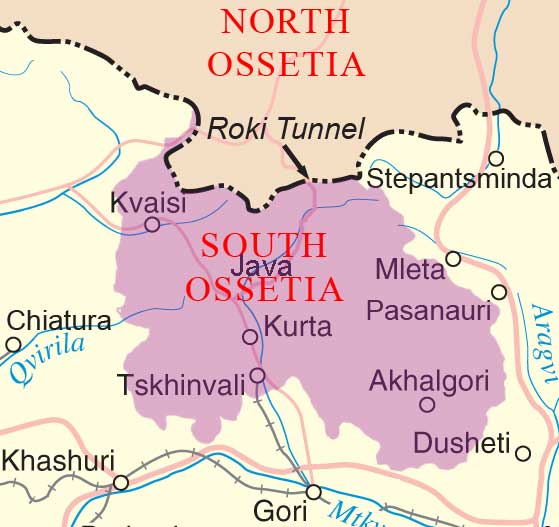
South Ossetia Map with Java

Analysis by LiveJournal user davnym_davno

1.The regiment, which is permanently posted in the township of Prokhladny, close to Nalchik, [Kabardino-Balkar Republic], after finishing its exercises (August 2nd), was stationed to Nizhny Zaramag.

2.Nizhny Zaramag is located several kilometers from the northern entrance of the Roki tunnel, and a border station and customs office is located in this town.

3.On August 7th, the regiment received the order to move out toward Tskhinvali, was raised to a state of alarm, and before the end of the day, managed to arrive to its objective destination.

4.After midnight, the lights of the bombardment of Tskhinvali could be seen from the regiment’s position.

5.The site of the regiment’s position is not specified, but it is evident that the regiment passed through the Roki tunnel. Since:

*There would be no point in raising the regiment to a state of alarm to advance it two kilometers to the entrance of the Roki tunnel. With such a formation, the tail end of the column would still be in Nizhny Zaramag.

*Being located to the north of the Greater Caucasus Mountain Range [which the tunnel crosses], it would impossible to observe the lights of an artillery attack of Tskhinvali.

6.Going on the basis of the words, “we arrived, settled in,” one can draw the conclusion that the column did not as yet spend the night by the side of the road, but unloaded in a place where it was possible to provide the military personnel with food and a night’s rest.

7.Between the Roki tunnel and Tskhinvali, there is only one such place: Java.

Conclusion: the 135th motorized rifle regiment entered the territory of South Ossetia before the start of Georgia’s attack on Tskhinvali.

As is customary to say in such situations, ‘I rest my case, your honor!’

Georgia entered the war after Russia’s incursion onto its territory, in order to avert the threat of the country’s takeover, and forced regime change. In these circumstances, the attack on Tskhinvali was a tactical military objective, aimed at holding the enemy at bay in Java until the rest of the world reacted to what had happened.

The Georgian armed forces handled their objective even better that I expected. And you know yourselves what happened afterwards.

Who You Gonna Believe, Putin or Your Lyin’ Eyes?

Filed under: Economics,Energy,Politics,Russia — The Professor @ 4:46 am

I have noted before that when making the investment case for Russia, Putin, Medvedev and their pilot fish (or remoras) from the financial community claim that Russia is driven by its own strong fundamentals and is essentially decoupled from the American and European stock markets, but when anything goes bad in the Russian market, it’s the Americans’ fault (e.g., credit crisis). With the Russian market currently in near meltdown mode, the latter claims have become even more shrill. To wit, Putin’s and Medvedev’s recent penetrating diagnoses of the precipitous drops in the RTS and MICEX:

Vladimir Putin yesterday admitted that foreign capital inflows could fall by up to 45 per cent this year, but rejected suggestions that turmoil in Russia’s financial markets was caused by the conflict in Georgia.

The Russian prime minister said that the country was simply suffering from the same credit crisis affecting the rest of the world, but he acknowledged that foreign inflows might fall this year from $80bn in 2007 to $45bn or $50bn (€35.7bn, £28.5bn).

Mr Putin blamed Russia’s outflow of capital on “speculative” moves by western institutions withdrawing funds because of the “mortgage crisis” in the US and Europe.

But, speaking to western journalists in the resort of Sochi, he denied there was a liquidity crisis and rejected the view that the turmoil had “anything to do” with the Georgian conflict.

The US market has been moving largely sideways during a period when the Russian market has moved down approximately 45 percent. The recent precipitous drops in the Russian indices have not been matched by similar declines in the Dow or S&P, or any of the European indices. Indeed, for Putin’s story to make sense, one would have expected the Russian market to outperform (e.g., lose less) than the US market. The reverse has happened.

The far more plausible explanations for the Russian market implosion are (a) the Mechel episode and its aftermath, (b) the Russo-Georgian War, and (c) the sharp (approximately 40 percent) drop in oil prices post-July. For Putin (and Medvedev) to deny the obvious connections between their actions and the market’s reaction is a testament to either denial or chutzpah. It is particularly difficult to reconcile the sharp drop of the ruble relative to the Euro and the dollar with Putin’s United States-centric explanation. If US financial turmoil was the driving factor, the ruble should have been rising (as investors flee the dollar), instead of falling like a stone as it has.

During this interview, Putin dishes out more than usual dollops of his famous charm:

Mr Putin devoted much time to defending Russia’s intervention in Georgia, saying Moscow had had no choice but to respond to Tbilisi’s aggression in South Ossetia. “Should we have wiped the bloody snot off and bowed our heads again this time? What did you expect us to do, defend ourselves with catapults?”

In the three-hour meeting, Mr Putin appeared in complete command, giving the impression that he had ceded little, if any, authority to Dmitry Medvedev, his successor as president.

Asked whether he saw prospects of improvement in ties with the UK, the Russian prime minister offered little hope.

“Why do you use the territory of Great Britain to be used as a launching pad to fight Russia,” he asked, referring to the asylum granted to various Kremlin opponents including Boris Berezovsky.

“That’s why it’s not possible to have normal relations with the UK. If we had given safe haven to the militants of the IRA with weapons in their hands, what would you have done?”

This vulgarity is of a piece with Ivanov’s carpet f-bombing British Foreign Minister Miliband. It is especially pitiful when the elfin Medvedev feels compelled to talk like a capo to fit in with the overall mien of the siloviki dominated government.

I predict that the shrieks from Casablanca on the Moskva and the Kremlin to become even more shrill in coming days. Such shrillness is common when there is a yawning gap between reality, and what the speaker wants the audience to believe. (Hence, I also predict an increasing shrillness in the anti-Palin hysteria.)

Moral Hazard

Filed under: Economics,Politics — The Professor @ 3:14 am

On Sunday Treasury Secretary Hank Paulson announced plans to place Fannie Mae and Freddie Mac into conservatorship. If Paulson’s plan is implemented, the operations of the mortgage giants will be reduced dramatically over the coming years.

This is good news, in a way. These GSEs were a disaster waiting to happen–and it just happened. The government’s implicit guarantee of the debt of these enterprises–just made explicit–encouraged excessive risk taking, and excessive risk taking eventually leads to an implosion if the game goes on long enough. In recent years Fannie and Freddie had dramatically increased their interest rate and credit risk and house price risk exposure by purchasing and warehousing larger and larger quantities of mortgages, including large amounts of higher credit risk stuff. This increased their exposure to housing price risk (housing price declines raise the probability of default). When that price decline occurred, these highly leveraged institutions soon blew through their capital. (Arguably, the advantages of these institutions also encouraged greater risk taking by other financial intermediaries attempting to compete with them.)

It would of course have been better if the administration and Congress had responded to numerous, informed warnings of the inherent dangers posed by the GSEs by reining them in years ago. The administration tried, in a half-hearted sort of way, but Congress ardently defended Fannie and Freddie even in the face of accounting shennanigans that would have made Enron proud.

And that’s where the real moral hazard lies. At root, moral hazard exists when a decision maker is not accountable for his actions, when he is able to reap the benefits but somebody else pays the costs. Due to the arcane nature of the GSEs, the ability of Congress to deflect attention, the advantages of incumbency, and myriad other factors, Barney Frank and Chris Dodd and the others in Congress who have protected Fannie and Freddie at every turn will never, ever, pay a political cost for their actions. They have reaped the political benefits, in the form of campaign contributions and the channeling of Fannie and Freddie funds to their pet political causes in housing, but you and me and every other taxpayer will have to pay to clean up the mess. Few people who matter–the constituents of Frank and Dodd et al–will understand the connection between their actions and the F & F blowup, and what’s more, the costs are spread broadly among all taxpayers, the vast majority of whom would be unable to exact a punishment on the perps even if they had the information and incentive to do so.

It is nauseating in the extreme to see Frank and Dodd express not the slightest remorse for contributing to Fannie’s and Freddie’s disasters. Indeed, both have ardently defended the role of these institutions, and have stated that they intend to ensure that some entity continues to fulfill the redistributive functions of Fannie and Freddie, i.e., subsidizing home ownership and the construction of low income housing.

In the past, F & F supported these functions out of the cash flows generated from its for-profit operations. These operations, in turn, benefited from the funding cost and competitive advantages associated with their special status as GSEs, and the implicit federal guarantee. The whole idea here was to run a shell game that provided monies for certain activities desired by certain politicians without requiring explicit claims on tax revenue. Nonetheless, as was long apparent–and as is now painfully evident–the implicit claim on taxpayer revenues was very real. These entities were, in some degree, analogous to royal monopolies from medieval or mercantilist times, whereby the crown granted special privileges to certain companies in exchange for the companies’ support of activities desired by the crown.

Frank, Dodd, et al, want to continue the shell game, and want to continue to support favored activities without the discipline and accountability (such as it is) of the normal appropriations process. Thus, they will fight tooth and nail to maintain as much of the F & F structure intact. The inexorable logic of this kind of structure creates moral hazard, and if Frank and the gang get their way, sometime not too far into the future, some Son (or should it be “Daughter”) of Fannie will require another bailout. And thus, the lack of political accountability creates the true moral hazard that is at the root of our current financial travails.

September 11, 2008

Panic

Filed under: Politics — The Professor @ 8:00 am

I spent the last week in Switzerland and Austria. I spoke at the Swiss Futures and Options Association meetings in Interlaken, a delightful place. The event itself was nice, but unexceptional. The most interesting experience was a lunch with several European participants.

My four companions were interested to learn from me, the only American at the table, what I thought about the upcoming election. I gave them the shock of their lives when I opined that I gave McCain far better than even odds of winning. They pressed me to know why. I gave several reasons: (1) no one as left as Obama has ever been elected president; (2) Obama has never been in a contested election, and is very likely to make a major mistake in the pressure cooker of a presidential contest; (3) the election will hinge on working class and middle class voters in a handful of states, Pennsylvania, Ohio, Michigan, and Missouri, and Obama has not done well with those voters in those states; (4) Palin’s selection dramatically improves McCain’s chances with those voters; and (5) Obama’s political skills are overrated, and he has been sheltered from scrutiny by a friendly media during a time when attention is less intense, but that won’t be the case in the last two months of the race.

My analysis may be right or wrong–we’ll see. That’s not the point. The point is the reaction of my lunch companions. They were clearly unsettled by the prospect of an Obama defeat. I think that they considered his victory inevitable–and desirable. The possibility of a McCain triumph frightened them.

One guy has a very responsible position in the European Commission, and was formerly in the government of a large EU state. He was visibly distressed at my prognostication. He became extremely agitated, fidgiting in his chair. Not that he disagreed with me, I don’t think–he didn’t challenge my reasoning. No, I think he was agitated because he thought I might be right, and the prospect mortified him. He stammered–I exaggerate not, he was stammering–“How could the US elect a woman who only received a passport 2 years ago?!? Americans are so insular.” The idea that somebody so uncosmopolitan could be even considered for national office was utterly fantastical to him.

He then asked me whether Americans didn’t understand how popular Obama was in Europe. I said “They know all right, and to be honest, the screams of 200,000 Germans is just what might have cost him the election. Most Americans don’t care what Europeans think, and some Americans–including those likely to be pivotal in this election–certainly don’t like taking instruction on whom to vote for from Europeans.”

One of the other people at the table thought it was shocking that the fate of the world rested in the voting choices of a few million working class Americans. The condescension was palpable.

My takeaway–the insularity goes both ways. Europeans are insular in their own way. They have their worldview, and have a hard time comprehending that not everybody shares it. Moreover, the media cultures in Europe–and the US–feed this insularity. If you get your idea of what Americans think from the New York Times, well, you are pretty uninformed.

All of this transpired early in the morning (US time) of the day of Palin’s speech. I can only imagine how the angst has increased in the days since, with McCain’s surge in the polls, and Obama’s string of miscues.

I can see McCain’s new ad: “Tick off a Frenchman (or Italian or German): Vote for McCain-Palin!”

Upon reflection, I think that the fact that my interlocutors seemingly agreed with my prediction, as much as they disliked it, is just another manifestation of anti-Americanism: “Of course Obama is far and away the better candidate, but the Americans are so stupid they can’t be expected to vote for him.”

Here’s hoping that they’re right about that.

September 10, 2008

Chronologies III

Filed under: Military,Politics,Russia — The Professor @ 9:41 am

Here are some more details regarding the timing of events on August 7-8.

From a Georgian government timeline:

At 23:30, Georgian Government receive multiple human intelligence reports that about 150 armored vehicles and trucks with Russian soldiers are approaching the Roki Tunnel from Russia and moving towards Tskhinvali. Multiple signal intercepts of separatist security and military officials at around 3am and later confirm that columns are stretched from Roki to Java. (Sigint)*.

At 23:50, for the first time, and in response to the entry of Russian armed forces into Georgian sovereign territory, Georgian armed forces enter military action ­using armor, including tanks, 122mm howitzers, and 203mm self-propelled artillery system Dana.

At approximately 00:45 on August 8, Georgian forces fire artillery rounds at the invading Russian forces on roads being used by a Russian column already moving south of the Roki Tunnel.

From a somewhat even-handed piece (though it tends to favor the Russian interpretation in its failure to discuss key issues) in Der Spiegel:

On the same day, a maneuver called “Caucasus 2008,” under the command of high-ranking General Sergei Makarov, the commander of the northern Caucasus military district, began on Russian territory north of the Caucasus ridge, between the Black Sea and the Caspian Sea. The exercise included 8,000 troops from all branches of the military. Troops with the 76th Air Landing Division, from Pskov, conducted their exercises openly on a military training ground in the Daryal Canyon, not far from the Roki Tunnel to South Ossetia — the eye of the needle between Russia and Georgia.

According to claims coming from Moscow, Russia’s troops in the field were prepared to “come to the aid of the Russian peacekeepers” stationed in South Ossetia. The government in Tbilisi was quick to respond, noting that it was unaware of a “right to conduct any actions on Georgian soil.”

Western intelligence agencies observed that, after the July 30 end to the “Caucasus 2008” exercises ended, the dispatch channels set up by the Russians were kept in place, hardly the usual practice following military exercises. Furthermore, the 58th Army remained in a state of heightened readiness. For US intelligence, with its arsenal of spy satellites, reconnaissance
aircraft and unmanned drones, this should have been a reason for concern.

More from D-S:

According to Western observers, by the morning of Aug. 7 the Georgians had amassed 12,000 troops on the border to South Ossetia. Seventy-five tanks and armored personnel carriers were in position near Gori. In a 15-hour blitzkrieg, the tanks were to advance to the Roki Tunnel to seal it off. At that point, there were only 500 Russian soldiers and another 500 fighters with the South Ossetia militia armed and ready to defend Tskhinvali and the surrounding area. At 4:06 p.m., the South Ossetian authorities reported that Tskhinvali had come under attack from grenade launchers and automatic weapons. Fifty minutes later, they reported “large-scale military aggression against the Republic of South Ossetia.” According to Western intelligence sources, the Georgian artillery bombardment of Tskhinvali did not begin until 10:30 p.m. on that Thursday. It was orchestrated by 27 Georgian army rocket launchers capable of firing ordnance with a maximum caliber of 152 millimeters. At 11 p.m., Saakashvili announced that the goal of the operation was the “re-establishment of constitutional order in South Ossetia.”

A Disastrous Decision

During his invasion, the Georgian president relied primarily on infantry units that had to advance along major roads. At 11:10 p.m., the Georgian side informed the general in charge of the Russian peacekeepers that they planned to use military force to re-establish “constitutional order” in the Tskhinvali Region, the Georgian term for South Ossetia. Half an hour later, a Georgian grenade struck the roof of a three-story building occupied by Russian troops, killing two soldiers on observation duty.

Salvos from multiple rocket launchers rained down on the complex. The peacekeepers’ cafeteria was reduced to rubble and all of the buildings went up in flames. Eighteen Russian soldiers died in the attack. Four minutes before midnight, the South Ossetian authorities reported: “The Georgian armed forces’ storm on Tskhinvali has begun.”

No mention here of (a) South Ossetian shelling using 122mm weapons prior to the Georgians opening fire, and (b) what the Russians that D-S acknowledged had remained in a high state of alert were doing, although later on the piece states:

Starting at 2:06 a.m. on Aug. 8, the tickers of international press agencies began running reports of Russian tanks in the Roki tunnel. Depending on the estimate, the Russians moved between 5,500 and 10,000 soldiers into South Ossetia through the Roki tunnel. Meanwhile, there were already between 7,000 and 10,000 Russian soldiers at the Georgian-Abkhazian
border, many of them brought there on ships from Russia. The “Moskva,” a guided missile cruiser and flagship of Russia’s Black Sea fleet, with the fleet commander himself on board, was patrolling off the Georgian coast.

From a Central Asia-Caucasus Institute paper:

Shelling and shooting between the Georgian armed forces and South Ossetian rebels resume in the afternoon, killing and wounding several servicemen from both sides. In Tbilisi, the Georgian authorities receive foreign intelligence reports about movement of Russian troops towards the Roki tunnel, connecting North Ossetia with the South Ossetian conflict zone. Georgian President Saakashvili consults Western diplomats and is advised by U.S. Deputy Assistant Secretary of State Matthew Bryza not to fall into a trap and to avoid a confrontation with Russia.

At approximately 7 PM, the Georgian government announces its decision to cease fire in order to defuse tensions and offers to engage in talks with the South Ossetian side. A few hours later the Georgian authorities report that several Georgian-controlled villages, including Avnevi, Prisi and Kurta, have come under heavy fire from the South Ossetian side. According to multiple and consistent Georgian sources (including witnesses to the discussions), at approximately 11 PM Georgian President Mikheil Saakashvili receives information that a convoy of over 100 Russian military vehicles is passing through the Roki tunnel. The Georgian government informs U.S envoy Bryza that it has no other choice but to advance towards the tunnel in an attempt to push the Russian troops back. Shortly before midnight, the Georgian Ministry of Defense announces its decision to restore the constitutional order in South Ossetia.

Russian Defense Ministry sources, meanwhile, claim its forces did not enter Georgia until the afternoon the next day, but have failed to state the exact time of entry.

August 8, 2008
From midnight on August 8, Georgian troops begin an attack intended to destroy the road connecting the Roki tunnel with Tskhinvali, and advance towards the breakaway capital. Georgian forces seize several South Ossetian controlled villages located on higher ground around the breakaway capital.

According to Georgian authorities, at approximately 1 AM the troops succeed in shelling the road south of the Roki tunnel, thus delaying the advance of the Russian convoy. At 2 AM, Georgian ground troops reach Tskhinvali and begin firing rockets against governmental buildings in the city. The shelling of the city continues overnight. In the early morning, the Georgian side reports that additional Russian troops have passed the Roki tunnel and are advancing towards Tskhinvali. At 8 AM, the Georgian air force bombards the Gupta bridge (connecting the region of Java, south of the Roki tunnel, with Tskhinvali), delaying the advance of Russian units on approach to Tskhinvali.

Even Russia Blog’s Kremlin running dog Niolai Petro admits in his timeline:

01:30 – The Georgian Foreign Ministry reports that the “first Russian troops enter through Roki Tunnel.” [G5] Three days later it will say that 100 Russian vehicles crossed through the Roki tunnel into Georgia six hours earlier, at 19:30 GMT on August 7. [G6] The first international press agency reports of Russian tanks in the Roki tunnel appear almost exactly between these two accounts, at 22:06 on August 7 [Note that this is 3 hours earlier than the time reported in the Spiegel piece. The fact that the minutes line up suggests that maybe the two are using different time zones.]

It seems pretty clear from all this that the Russians were moving towards the Roki Tunnel before the Georgians began their heavy shelling, and were in the Tunnel at or before the commencement of the bombardment. Based on the 22:06 time for the international press reports of the Russian movement through the Roki Tunnel, and the 22:30 commencement of the Georgian barrage, it is obviously impossible for the Russian movement to have been a response to the bombardment. Even based on a 0130 or 0200 time of a movement through the Tunnel, given the fact that it would have taken hours to commence the movement, it could still not have been the case that the bombardment precipitated the Russian advance.

The most charitable interpretation that one can give is that the Russians had observed the Georgian buildup, and were attempting to preempt an anticipated Georgian attack on Tskhinvali. Knowing that the Roki Tunnel was the key, and that they would be helpless to intervene in strength if it were blocked, in this interpretation the Russians moved to ensure that the Georgians could not block it. Even in this interpretation, however, it is credible that Saakashvili’s final decision to attack was spurred by the symmetric realization that if the Russians made it through the Tunnel, his fate was sealed. What is not known, and what can never be known, is what would have happened if the Russians had not begun their movements to Roki at the time the fighting was escalating. That was certainly a sufficient condition for Georgia to attack; we cannot know whether it was a necessary one.

Re the timing issue, certainly the US could answer definitively when the Russian forces began to move, but as Pavel Falgenhauer has noted, US intelligence is being reticent. If true, the CACI statement that the Georgians received reports of Russian movements from western intelligence does make it clear, however, that we were monitoring Russian deployments in real time.

Given the totality of circumstances, the most credible interpretation is that Russia had laid the groundwork for an attack for months, escalated the crisis in South Ossetia, and then pounced when Saakashvili responded. This is not the only interpretation. Another is that, in some ways analogous to WWI, when railroad timetables and mobilization schedules created a momentum towards war, operational imperatives (keep the Roki Tunnel open! Close the Roki Tunnel!) set off a cascade of actions and reactions that culminated in conflict. Neither side could afford to let the other steal a march, and the resulting non-cooperative equilibrium was a war.

Even here, however, it is evident that the escalation of bombardments by the South Ossetian separatists was a crucial part of the mix. That’s what drew the Georgian heavy forces from Abkhazia to Gori and the Ossetian front, thereby initiating the cascade of movements towards Tskhinvali from north and south. The Russians certainly appear to have done nothing to keep the Ossetians on a short leash. That, plus the maintenance of the high degree of alert plus all the other elements pointing to Russian preparation, continue to point me to the conclusion that this was a war of choice for Russia. Put differently, the predicate for the race-to-Roki equilibrium was a Georgian presence in force in Gori and environs. The evidence strongly suggests that the Georgian presence was a direct response to escalating Ossetian separatist artillery activity, activity the Russians and Russian “peacekeepers” did nothing to rein in.

Its actions after the initial combat in South Ossetia, including its attacks in Abkhazia and beyond the borders of the disputed enclaves, its immediate recognition of the breakaway republics, and its demands (reiterated last week) that the west cease support for Saakashvili and that the Saakashvili government be replaced, suggest a motive far deeper than a desire to protect South Ossetia from Georgian attack. This further bolsters the war of choice conclusion.
September 1, 2008

She Channeled Cactus Jack

Filed under: Uncategorized — The Professor @ 12:23 am

The worthy Beldar takes well-warranted umbrage at Tom Brokaw’s and the excreable David Gregory’s attempt to twist a Sarah Palin quote to mean that she doesn’t know what the Vice President does.   Beldar reproduces the entire quote, but in a nutshell what Palin said was that she knows that the responsibilities of the Vice President are essentially negotiated with the President, and she wanted to make sure that the job would be offered to her on terms that she considered attractive.   In other words, she took to heart what FDR’s VP, Cactus Jack Garner, said: the Vice Presidency is “not worth a bucket of warm piss.”   [This quote was subsequently softened to “not worth a bucket of warm spit” out of deference to tender ears.]   In other words, Palin was making it clear that she would be interested in the job as long as the responsibilities were not limited to guarding the thunder pot (or the spittoon, for you sensitive types.)   Smart lady, in other words.

« Previous Page

Powered by WordPress