Streetwise Professor

January 10, 2016

Protectionism in the Oil Patch: When Someone Says “Fair Markets”, Check Your Wallet

Filed under: Commodities,Economics,Energy,Politics,Regulation — The Professor @ 9:28 pm

The decline in oil prices is producing a predictable political outcome: attempts to prop up the domestic US industry. Some initiatives would make sense regardless of the financial distress of the US upstream sector: the Clinton and Obama administrations in particular have imposed a variety of inefficient regulations and restrictions on US hydrocarbon production, and it would be desirable to roll these back, as is being proposed:

Among the proposals under discussion: Expediting the process for exporting liquefied natural gas, and upgrading infrastructure to move energy to market more quickly and cheaply.

Another top priority for the two Republicans is loosening environmental and other regulations.

But then there’s just the plain stupid:

Some lawmakers are floating the possibility of taking retaliatory trade measures against Saudi Arabia, which has flooded the market with cheap oil in what some analysts see as a bid to drive America’s growing shale oil industry out of business.

. . . .

North Dakota Rep. Kevin Cramer (R) said lawmakers could begin to mull retaliatory tariffs against Saudi Arabia in the future but emphasized he is not advocating for that yet.

“I’m very hesitant to go down that path at this time but clearly that would be a possible option should the Saudis not play fair. Because as much as I advocate for free and open markets, I also advocate for fair markets,” he said.

Saudi Arabia, taking advantage of its low extraction costs, has refused to curb oil production in a bid to expand market share and undercut competitors. This has raised the prospect of the U.S. government taking action to level the playing field for domestic companies.

“I’m not prone to a lot of government intervention in terms of propping industry up, per se. What would be the most helpful is to roll back regulations that get in the way of further development and profitability,” said Cramer, who cited the Endangered Species Act as one burdensome regulation.

“Obviously they have access to our market and I suppose to some degree there is a role that can be played there. I’m not at the point where I’m ready to advocate tariffs or restricting their access necessarily,” he added.

Any tariff on Saudi imports would be special interest protectionism pure and simple, tarted up in the usual rhetoric (and whining) used to justify protectionist measures. “Fair markets” is a sure tell. Anyone who says “I’m for free markets but they should be fair markets” is a liar, and should drop the pretense. Any such person is all about protecting a favored industry or firm. When someone, regardless of party, says “fair markets”, I strongly advise you to check your wallet, because they are trying to rob you.

And why should Saudi Arabia “refuse to curb oil production”? Indeed, “curbing oil production” is the exercise of market power, for which the US (rightly) criticized OPEC and the Saudis in the past. What’s more, low cost producers are the ones who should sustain output in the face of a demand decline: high cost producers are the ones who should cut back.

Furthermore, although North Dakota is an oil long, the US as whole is an oil short, still producing only about 1/2 of its consumption, despite the spurt in oil production in the past 5-6 years. So low oil prices are still in the interests of the US.

It should also be noted that the “flooding the market with cheap oil” meme is vastly overstated. Saudi output in June, 2014, right before the price collapse began, was about 10mm bpd. It is now about 10.5 mm bpd. That difference represents a whopping .5 percent of world output. Even given an elasticity of 10 (which is probably too high) that could cause at most at 5 percent decline in prices. As I write, Brent just went below $33/bbl, and hence is down almost exactly 70 percent off its pre-collapse levels. So this collapse is not the result of the Saudis flooding the market.

Nor are the Saudis engaged in some predatory pricing strategy. At least I doubt that they are, because such a strategy would be irrational.

The price decline is the result of increased output in a variety of places (including the US), but mainly due to a steep decline in demand growth, especially from China.

Yes, the upstream sector in the US is suffering severe financial distress. So be it. That’s the nature of the business, and the nature of a market system generally. Resources should exit sectors that suffer demand declines. They should not be propped up through trade restrictions, especially trade restrictions that will impose far greater costs on the US economy as a whole than they will benefit one sector in that economy.

It is also perversely ironic that the very same Republicans (I am speaking of the individual legislators, like Murkowski and Cramer, not the party as a whole) who pushed for ending the idiotic export ban are now mooting an equally idiotic restriction in imports. This makes it plain that it’s not about principle, in the least. It’s all special interest politics. That’s not surprising, but it’s not admirable. And it’s not any better when Republicans push it than when Democrats and Obama do.

So yes, eliminate or cut back inefficient restrictions that a relentlessly anti-hydrocarbon administration has imposed, in order to eliminate unnecessary burdens on US oil and gas production that hurt both US producers and consumers in the US and around the world. But don’t impose large costs on American consumers of oil in order to prop up the US upstream sector. The sector should shrink if the demand for its product declines due to increased production elsewhere, or reduced demand. So be it.

December 29, 2015

Spoof Me Once, Shame on You: Spoof Me Twice, Shame on Me

Filed under: Commodities,Derivatives,Economics,Exchanges,Regulation — The Professor @ 6:41 pm

I’ve often written that HFT firms are the best able to detect spoofers, and to take preventative measures (which reduce the profitability of spoofing, and hence its prevalence). The whole business of HFT is extracting signals from orders and order flow, and trading accordingly. Spoofing is based on manipulating the order flow–in essence, injecting noise into it. HFT firms evaluate their executions, and attempt to identify patterns that predict both winning and losing trades. If spoofers systematically impose losses on HFT firms, eventually the latter will figure it out.

This is the first article that I’ve read that supports this contention:

Inside Ken Griffin’s $25 billion empire, Citadel’s cyber investigators had isolated a new enemy: spoofers.

It was late 2013, and at the firm’s Chicago headquarters, a team of researchers discovered that a rival company’s algorithm was outmaneuvering their automated trader. The algo was placing futures orders it had no intention of filling to entice firms like Citadel into the transactions, then canceling them, leaving Citadel with money-losing trades. Citadel’s plan: to pit its computers against the spoofer in a high-stakes duel over market manipulation.

. . . .

Vertex Analytics may have devised a way to make high-frequency trading more transparent and spoofing easier to detect. The Chicago-based technology firm can represent graphically every order and transaction on CME’s markets, obviating the need to go through pounds of paper searching for a telltale sequence of

Vertex’s approach was a revelation for Robert Korajczyk, a finance professor for more than 30 years at Northwestern University, where he’s studied asset pricing and liquidity.

“My first reaction to seeing the graphics capabilities was ‘This can’t be done,’” Korajczyk said. “However, Vertex can do it.”

. . . .

Citadel isn’t the only firm that took measures against spoofers without regulators’ help.

In 2012, Chicago-based HTG Capital Partners detected a pattern of large canceled orders followed by aggressive trades in the opposite direction that left them with losing positions, according to an affidavit released last month. The firm created tools to help identify when spoofing was taking place, the affidavit said.

Transmarket Group has created an “anti-manipulation guide” that tells traders how to spot spoofing, according to a copy seen by Bloomberg News. The Chicago-based firm lists specific examples of spoofing in the natural gas market on CME as part of the guide.

The article spends a lot of time discussing enforcement actions against spoofers, and the difficulties of making a case. Even ignoring my doubts (expressed in earlier posts) whether the social costs of spoofing really warrant expensive enforcement efforts, the fact that sophisticated and knowledgeable players have the incentive to detect this kind of conduct, and take defensive measures (and perhaps offensive–at least that’s what the description of Citadel “pit[ting] its computers” against spoofers suggests) means that the frequency and scale of spoofing activity is likely to decline significantly. It is a pathogen that found a niche, but the hosts’ immune systems are adapting, and it will become less dangerous in short order.

This isn’t true of all forms of manipulation, but the very nature of spoofing–which involves doing things that are intended to be detected–makes it vulnerable to detection and countermeasures. This means that the system tends to be self-correcting, and this mitigates the need for enforcement. Unfortunately, it appears that enforcement officials (both civil and criminal) think otherwise, and have prioritized the prosecution of spoofing. Combined with the outrageous overcharging and over-penalizing that I’ve mentioned before, this is a disturbing development.

December 26, 2015

Is Russia Like the One Hoss Shay?

Filed under: Economics,Politics,Russia — The Professor @ 7:59 pm

This piece in War on the Rocks challenges seven common beliefs about Russia. Two were of particular interest.

The first challenges the view the Russia is brittle. As someone who long ago advanced this hypothesis, I challenge the challenge. The basic problem is that I don’t think author Michael Kofman really understands the concept of brittleness. Here’s what he says:

With each new outbreak in what has become an almost routine series of political, economic, or foreign policy crises, a segment of the Russia-watcher community invariably begins to make predictions of Putin’s imminent demise. Unfortunately, the science of predicting regime change seems to lag significantly behind astrology. We should remember that few predicted the Soviet Union’s rapid demise, the start of the Arab Spring, or anticipated the rapid fall of Victor Yanukovich in Ukraine following the start of the Maidan.

There are two ongoing case studies on the merit of such predictions. The first is Pakistan, a country that by the same theory should have collapsed long ago under the weight of its many problems. The second is North Korea, which soldiers on despite decades of predictions and estimates of the regime’s imminent implosion. As former Secretary of Defense Robert Gates remarked on our ability to predict the nature and location of the next conflict, “our record has been perfect” given that “we’ve never once gotten it right.” The same should be said of our ability to judge regime brittleness. The point is not that neo-Kremlinology or assessments of political stability are a waste of time, but that this is a single layer of analysis that should be taken with a healthy dose of skepticism.

The point about brittleness is exactly that the process is not linear and that collapse occurs suddenly and unpredictably. Brittle systems survive most things, but when they fail, they fail completely and suddenly . . . like the USSR, Arab regimes, and Yanukovych.

Brittleness arises from coordination games in authoritarian regimes. Preference falsification is one mechanism. Coercive mechanisms and social pressures induce people to claim allegiance to an authoritarian regime, or remain silent, even when they don’t like it. This can be self-reinforcing, because people don’t receive contradictory information, and think that their own dissatisfaction is not widely held, and thereby remain silent (or feign support) which convinces others that their dissatisfaction is not widely held, and on and on. This system is stable, until some shock (a military adventure gone wrong, for instance, or an economic calamity, or an incompetent response to a natural disaster) induces enough people to express their opposition to convince the remainder that their dissatisfaction is indeed widely shared. The equilibrium then flips from uniform support or acquiescence to widespread opposition.

Preference falsification is a brittleness mechanism that works through the broad populace. Natural state mechanisms work through the elite. Elite support for the regime is predicated on the beliefs that it commands control over enough resources that can be distributed to the elite, and that this control will endure for some time. When an adverse economic shock reduces the stream of rents that is used to buy elite support, or if the durability of the regime comes into question (due, for instance, to a health crisis at the top of the regime), the elite can suddenly withdraw support or challenge the existing leadership, leading to regime collapse.

Both of these mechanisms are non-linear. Small shocks can lead to large changes. Since the shocks are unpredictable, the shattering of a brittle regime is unpredictable as well.

Highly personalized and institutionally impoverished systems tend to be more brittle, in large part because these systems are more dependent on the vagaries of individual health, personality, and sanity. In this respect, it is interesting to consider the case of Stalin. The Soviet system survived Stalin’s death in part because it did have developed institutions that facilitated succession. Putin, in contrast, has followed the more traditional authoritarian approach of becoming the indispensable person. Such as system is inherently more brittle.

The second point I’d like to challenge is related to the first, namely, whether Putin (and the Russian government generally) is obsessed with regime survival. Kofman argues that this is an empirically empty hypothesis.

This is incorrect. Putin is clearly obsessed with regime change. Look at his rhetoric on color revolutions and the Arab uprisings. He sees dark plots everywhere, most of them emanating from the US. His fears are matched by actions. Putin’s resumption of the presidency, and the relentless campaign to control civil society and eliminate independent media especially in the aftermath of the late-2011 protests are the clearest examples domestically, and the hysterical response to Ukraine, Syria and even backwaters like Montenegro are the foreign policy manifestations of this fear. The obsession with stability at home and abroad is also symptomatic of of concerns about regime survival.

The domestic reactions are classical authoritarian responses to anxieties about brittleness. Controlling information enforces the preference falsification equilibrium. The confident don’t fear open expression of discontent. Those who know that stability depends the shared belief that the regime has near universal support, do.

Obsession with regime survival is an acknowledgement of brittleness: that’s why these concepts are related (though Kofman does not connect them, which is revealing). Michael Kofman may not believe that Russia is brittle, but Putin’s behavior strongly suggests that he does.

Again, the whole point about brittle regimes is that the timing of their demise is almost impossible to predict, as that brittleness is a non-linear process that involves the risk of a large and sudden change in equilibria in response to a modest shock. Non-brittle systems muddle along. Brittle regimes don’t: they sometimes fall to pieces all at once, like the one hoss shay.

December 25, 2015

Four Corners Offense: The Social History of Commodity Corners

I’ve been spending something of a busman’s holiday, reading this and that about commodity market corners in days long past. I started out looking into some of the big cotton corners at the beginning of the last century, namely the Brown-Hayne corner of 1903 and the Patten corner of 1910. These are the subject of a new book, The Cotton Kings: Capitalism and Corruption in Turn-of-the-Century New York and New Orleans. The book is entertaining history, but could use some more economics. It is journalistic in style, rather than analytical.

Reading about Patten’s cotton corner led me to read about his wheat corner of 1909, his corn corner of 1908, and his oats corner of 1902. Mr. Patten was a busy man.

And a reviled one. He was known as “The Wheat King,” whom the The Literary Review accused of  “The Crime of Making Bread Dear.” He was the model for the villain in the very influential D. W. Griffith short film, “A Corner in Wheat.”

This early short was one of the first films, if not the first, to address a serious social subject. Its theme would be very familiar today: the two Americas, rich and poor. Sergei Eisenstein admired Griffith, and employed his “parallel editing” technique (which he referred to as Griffith’s “montage of collision”): some film historians consider Griffith’s technique more subtle and less heavy-handed than Eisenstein’s.

(Unbeknownst to me when I was growing up in Evanston, Illinois, Patten was a longtime resident of the city, and its former mayor. He built a mansion there, and funded the Patten Gymnasium, where I swam in the summers.)

Patten was a nationally known figure. The Justice Department indicted him under the Sherman Act for his cotton corner, and the case attracted front page attention in national newspapers, including the New York Times, when it went to the Supreme Court. (Patten was fined $4000, or less than .1 percent of what he allegedly made in his corner. Not much deterrence effect there, eh?)

Patten was not alone in being a figure of national renown–and infamy. Commodity speculators were the banksters of their day. The Matt Taibbi of the 1880s, Henry Demarest Lloyd, wrote about cornerers at the Chicago Board of Trade in a famous essay. Frank Norris wrote a famous roman à clef, The Pit, based on the Leiter wheat corner of 1898.

In sum, in the last third of the 19th century and the first quarter of the 20th, commodity markets generally, and commodity market corners in particular, were the subject of intense interest. In some respects, it is not surprising that commodity corners were the subject of close journalistic coverage, serious fiction, social critical literature, and film during this era. Agricultural commodities were much more central to Americans as both consumers and producers. In 1900, 41 percent of the American workforce was employed in agriculture: now it is under 2 percent, and agriculture represents less than .7 of GDP. Half of American consumption spending went to food and textiles in 1900: a century later, that figure was down to 20 percent. Relatively speaking, the commodity derivatives markets (the Chicago Board of Trade, the Minneapolis Chamber of Commerce, Kansas City Board of Trade, the New York and New Orleans cotton exchanges, etc.) were more important and more developed that the capital markets, including the New York Stock Exchange, than is the case today: by the 1990s, when I was researching commodity exchanges and doing work with some, the commodity traders lamented that the explosion of financial futures had led the managements of exchanges to lose touch with the realities of commodities.

That said, one can see many echoes of the distant debates about and social criticism of commodity trading and corners in current controversies over financial markets. Just as outrage over the alleged excesses of the 2000s gave birth to the spate of post-Crisis financial regulation, fury over the Leiters and Pattens and Browns led to the first major regulations of financial markets in the United States: the Cotton Futures Act of 1914, and the Grain Futures Act of 1922 (which morphed into the Commodity Exchange Act, which is still with us, and which was amended by Frankendodd). Both Acts followed major government studies, the Commissioner of Corporations’ Report on Cotton Exchanges, and the Federal Trade Commission’s Report on the Grain Trade. Both of these are very well done, and provide very detailed descriptions of both the cash and futures markets. They are priceless resources. In some respects, because of them, we know more about the operation of commodity markets in the first decades of the 20th century than we do of their operation in the first decades of the 21st.

Maybe someday I’ll write a book about all of this, one that integrates the economics, history, and political economy. It’s of great personal interest, but not highly valued in the economics or finance professions today. I was amused when I came upon the link to an AER article about the Cotton Futures Act: it is beyond imagining that something similar would appear there today. But as I hope the foregoing shows, plus ça change, plus c’est la même chose. Issues of the relationship between financial markets and the real economy, the political economy of financial markets, and the influence of financial titans on political and judicial institutions, are still with us. In 1909, a film like A Corner in Wheat grappled with the social impact of finance in a very provocative and arguably simplistic way: in 2009-2015 movies like Too Big to Fail, Margin Call, and The Big Short do the same.

Don’t hold your breath, but maybe someday you’ll read about this in depth in print, rather than superficially in pixels.

December 22, 2015

Embarrassing Silliness on Commodity Market Financialization in the FT

Filed under: Commodities,Derivatives,Economics,Energy — The Professor @ 8:04 pm

Satyajit Das writes some smart things. He also writes some silly things. This article in the FT is definitely in the silly category. Embarrassing is more like it.

Das claims that “increased financialisation” has “exacerbated” the downturn in commodities. What does he mean exactly?

Let’s start with the what Das means by financialization. (I’m ‘Merican and I’ll spell it like a ‘Merican, dammit!) This has become a term of art to mean traditional financial investors (pension funds, hedge funds, retail investors etc.) taking on direct exposure to commodity price risks, usually via derivatives (including ETFs). But Das treats anything touching finance as financialization. His use of the word is so broad as to be meaningless.

Cash flows from future sales were monetised to raise large amounts of debt to finance expansion. The collateral value of commodities secured expansion in borrowing and trading.

Uhm, when has this not been true in commodities? Commodity production tends to be highly capital intensive, which requires, you know, capital, which requires tapping the capital markets to, you know, fund. Since the dawn of capital markets, lenders and equity investors have mobilized savings to supply capital to miners, drillers, etc., to fund the digging of mines and the drilling of wells, based on the expectation of being paid back from cash flows from future sales. That’s exactly what finance is. If that is “financialization,” pretty much everything is “financialized” and the term is so general as to lack all meaning and analytical bite.  Modern markets have always been financialized in this way.

Natural resource firms have long been major users of the capital markets. Indeed, many of the earliest stock and bond markets developed to finance commodity investments, and mining and E&P firms have long been leading names in major stock and bond markets. In that respect, commodities have been financialized a lot more for a lot longer than most sectors of the economy.

In fact, it is the very capital intensity of extractive industries (which made natural resource firms reliant on capital markets from the first) that  explains the boom-bust cycle. Most of the costs of natural resource extraction industries are sunk costs. Literally sunk: very expensive, very long-lived holes in the ground that can’t be undug and used for something else. If demand turns down after these investments are made, it usually makes economic sense to continue operating , because the variable costs of operation tend to be relatively low and can be covered even when prices are low. Since the capacity is long-lived, exit does not occur, meaning that low prices can persist for long periods. But that’s economically efficient when investment is largely irreversible.

Which brings me to Das’s next groaner:

The need to maintain cash flow to service debt requires production levels to be maintained, even if it is below cost. This delays the withdrawal of supply and correction of prices. It also destroys the value of equity, making it difficult for firms to raise new capital to reduce debt.

Producing “below cost” (by which I assume he means continuing to produce when prices are below cost) destroys cash flow, rather than maintains it, if cost is measured properly. It is optimal to operate as long as prices cover avoidable costs (e.g., variable costs, and fixed costs that must be incurred as long as output is positive), even if prices are below some measure of accounting cost which typically embeds sunk costs: you can’t judge economic operation by looking at income statements, which have sunk costs baked in.

This kind of continued operation doesn’t “destroy the value of equity.” To the contrary, it is shutting down when price more than covers avoidable cost that destroys the value of equity. The fact that avoidable costs in natural resource extraction tend to be low relative to total costs means that not exiting even when prices are low is economically efficient.  (Another implication of the cost structure of natural resource production is that it is typically efficient to produce either at capacity or shut down altogether.)

Debt costs reflect the sunk costs of investment. Sometimes–like now–cash flows are insufficient to cover the costs of servicing this debt for many firms. That’s what bankruptcy laws are for. If they work well, the continued operation (or not) of insolvent firms will depend on current and expected future margins between price and avoidable costs, not the Ghost of Sunk Costs Past.

Then there’s this:

For industries like shale gas and oil which were cash flow negative even at high oil prices because of the need to invest in new wells to maintain production, reduction in the supply of capital affects the ability of firms to operate.

Again, Das is apparently utterly confused about the proper cash flow concept to apply. If “maintain production at all costs” was truly the mantra of the E&P industry, the problem would not be financialization, but management retardation. Finance would be implicated only to the extent that financiers are similarly retarded and gladly shovel good money to them to permit continued value destruction. If anything, it is the need to access the capital markets that prevents retarded managements from wreaking havoc: few things are more destructive of value than CEOs with bountiful free cash flows that relieve them of capital market discipline. Cutting off capital from negative NPV projects is a boon, not a burden.

Finally we get to derivatives!:

Hedging ameliorated the effect of declining prices. Derivative gains contributed in excess of 30 per cent of revenues in the US shale industry in 2015

And this is a problem why? This is exactly the way “financialization” is supposed to work. It transfers price risks to those (namely, well-diversified financial investors) who can bear them at a lower cost. Yes, investment probably would have been lower, and prices higher, had this risk transfer mechanism not existed. But this doesn’t mean that the level of investment with an efficient risk transfer mechanism is too high: it means that the level of investment without one is too low.

More bad derivatives stuff:

Margin calls further complicate matters. An airline that has hedged future oil purchases at high prices may face margin calls that make unexpected claims on its cash flow.

Yes, cash flow mismatches on hedges can be a problem. Which is exactly why corporate end users strongly preferred (and prefer) OTC hedges which embedded credit to mitigate these problems.

More financialization evils, according to Das:

Financialisation altered fundamental industrial structures. Traditionally high barriers to entry, such as technology, expertise and access to capital, led to domination by large producers who planned and controlled production.

Now specialised resources service firms provide access to technology and the willingness of capital markets and non-traditional lenders to provide finance allows easier entry resulting in a more fragmented industry.

These are features, not bugs! These are benefits of financialization! Breaking down oligopolistic and monopolistic market structures is good, not bad!

At the same time, trading in financial claims on future commodity cash flows has encouraged institutional investment in the sector as part of diversification into new asset classes. Hedge funds and trading firms now act as quasi banks financing and facilitating risk management by commodity market participants.

So facilitating the flow of capital from savers to investors is a bad thing? Facilitating risk management is bad too? Who knew?

This is just bizarre:

This activity is marked-to-market daily or secured by the value of the commodity. Any change in value can trigger calls for additional collateral complicating cash flow management or force liquidation of holdings. Capital market investors may lack the ability to ride out prolonged corrections. It complicates dealing with financial distress and the necessary restructuring.

Tapping into a deeper pool of capital, which financialization (as defined by Das) allows, spreads the risks and makes it easier to ride out prolonged correction (which, again, are an inherent consequence of the cost structures/operational leverage of natural resource extraction), not harder. And the statement about complicating dealing with financial distress and restructuring is completely conclusory, with no supporting argument or evidence.

Yes, in a world with poorly developed financial markets, large scale investments in industries characterized by irreversibility and large scale (like natural resource extraction) are expensive to fund. “Financialization”–which in Das’s expansive usage, apparently just means lower cost access to bigger pools of investment and risk capital–indeed leads to a bigger natural resources sector. Yes, by its very nature this sector will inevitably go through protracted periods of low prices, which will impose losses on investors. But that’s a risk that they willingly choose to bear, in exchange for an expected return that they consider compensatory.

Das appears to be afflicted with Bastiat Disease, i.e., the inability to distinguish between the seen and the unseen. Das sees the financial carnage that the current natural resources depression has created, but hasn’t considered what would happen if the world was less financialized. What are the unseen consequences of that?

I can tell you: a poorer world.

There are some forms of finance that are wealth-destroying rent seeking. The financing and risk management of the production of minerals and energy are not among them.

December 21, 2015

Adam Smith Goes to Syria: How Bad Government Policies Turned Drought Into Famine

Filed under: Climate Change,Commodities,Economics,Energy,History,Politics,Regulation — The Professor @ 7:39 pm

The myth that global warming caused a drought which caused the civil war in Syria has been flogged repeatedly by the left, especially in the lead-up to the Paris farce: another example of the “elites” letting no good crisis go to (political) waste. As I discussed in March, there was indeed a drought in Syria, but no credible scientific evidence links the drought to climate change.

Droughts happen. What turned the drought into catastrophe in Syria was the depletion of groundwater by previous government-driven efforts to spur production:

Syria was such a successful producer that it became a net exporter of wheat for the better part of two decades — almost unheard-of in a region where most governments imported cheap wheat from abroad. According to ICARDA Director General Mahmoud Solh, the increased productivity netted the Syrian government more than $350 million a year . The country also kept a strategic reserve of wheat — usually about 3 million metric tons, enough to get it through a lean year or a price spike. In this most stable of dictatorships, nobody dreamed of a war.

But all that productivity came at a price. To produce these remarkable gains, Syria’s agricultural sector “mined” groundwater to irrigate farms. Experts predicted that this would lead to severe water Shortages. When a four-year drought struck in 2006, devastating 60 percent of Syria’s agricultural lands, the country’s groundwater was already depleted.

(This sounds a lot like Soviet agricultural malpractice.)

This brings to mind Adam Smith’s argument that bad government policy turns “dearths” caused by nature into famines:

The seasons most unfavourable to the crop are those of excessive drought or excessive rain. But as corn grows equally upon high and low lands, upon grounds that are disposed to be too wet, and upon those that are disposed to be too dry, either the drought or the rain which is hurtful to one part of the country is favourable to another; and though both in the wet and in the dry season the crop is a good deal less than in one more properly tempered, yet in both what is lost in one part of the country is in some measure compensated by what is gained in the other. In rice countries, where the crop not only requires a very moist soil, but where in a certain period of its growing it must be laid under water, the effects of a drought are much more dismal. Even in such countries, however, the drought is, perhaps, scarce ever so universal as necessarily to occasion a famine, if the government would allow a free trade.

It as not just the  Syrian government that contributed to spiraling food prices which created popular unrest in the Middle East that culminated in 2010-2011 (which the Muslim Brotherhood exploited in Egypt and Syria in particularly): US government policy contributed to the problem. In particular, US biofuels mandates that stimulated the production of ethanol drove up the price of corn by an estimated 30 percent, and as Brian Wright has shown, drove up all other grain prices as well (because corn is a substitute for other grains in both consumption and production). (I strongly recommend reading at least the introduction of the Wright paper: I’d quote in detail, but the online versions embed some devious feature that makes it impossible to copy-and-paste.)

It is sickly ironic that policies intended to reduce global warming pushed by the same crowd that falsely blame the Syrian drought and subsequent civil war on global warming (a) do nothing to reduce global warming, and (b) have done far more to exacerbate poverty and create social unrest  in the Middle East than global warming ever has or ever will.  Ethanol is an unmitigated disaster environmentally, economically, and socially. Yet the people Thomas Sowell trenchantly calls “the anointed” colluded with agricultural lobbies in the United States (encompassing both growers and processors) to inflict this monstrosity on the world.

How dare they–how fucking dare they–presume to lecture anyone on their obligations to “save the planet” and help the poor? Through biofuels policies alone they have inflicted huge misery and privation, and yet they have the audacity to try to exploit one of the consequences of these policies in order to ram more of their brilliant ideas down our throats.

Haven’t they done enough? Can they please now just go away?

Alas, we won’t be so lucky. These are our elites, after all, and we are stuck with them, like a case of malaria. And they are actually proud of stupid policies like biofuel mandates. There is no stupid that can equal the stupid of not just not learning from mistakes, but reveling in them.

Do you still wonder why the Trump phenomenon exists? The global reaction against the elites, of which Trump is just the most prominent example, is yet another baleful consequence of the failure of these so called elites. The reaction may be as bad as the disease, but let the blame fall where it should: squarely on the shoulders of those condescending fools whose allegedly good intentions have paved a superhighway to hell.

December 20, 2015

Russia v. Ukraine: Will the Concept of Odious Debt Have Its Day in Court?

Filed under: Economics,History,Politics,Russia — The Professor @ 4:39 pm

Ukraine has announced that it will default on the $3 billion debt to Russia incurred in the waning days of the Yanukovych government–or is it regime? For that distinction could prove to be important.

It is somewhat surprising to me that as of yet Ukraine has not formally invoked the concept of “odious debt,” even though it seems apposite. Although there were earlier legal precedents (notably, US repudiation of Cuban debts incurred by the Spanish government prior to 1898), the concept was formalized in the 1920s by (ironically) a Russian emigre, Alexander Nahum Sack. Sack wrote:

When a despotic regime contracts a debt, not for the needs or in the interests of the state, but rather to strengthen itself, to suppress a popular insurrection, etc, this debt is odious for the people of the entire state. This debt does not bind the nation; it is a debt of the regime, a personal debt contracted by the ruler, and consequently it falls with the demise of the regime. The reason why these odious debts cannot attach to the territory of the state is that they do not fulfil one of the conditions determining the lawfulness of State debts, namely that State debts must be incurred, and the proceeds used, for the needs and in the interests of the State. Odious debts, contracted and utilised for purposes which, to the lenders’ knowledge, are contrary to the needs and the interests of the nation, are not binding on the nation – when it succeeds in overthrowing the government that contracted them – unless the debt is within the limits of real advantages that these debts might have afforded. The lenders have committed a hostile act against the people, they cannot expect a nation which has freed itself of a despotic regime to assume these odious debts, which are the personal debts of the ruler.

The key criteria established by Sack fit in the Ukraine-Russia case quite well. Yanukovych’s regime quite clearly utilized the debt to “strengthen itself” and “to suppress a popular insurrection.” If anything, the debt was used contrary to the interests of the nation. Putin provided the debt in order to make it financially feasible for Yanukovych to reject an EU association agreement, even though this agreement was widely popular in Ukraine. Furthermore, it is quite clear that the lender–Russia/Putin–were knowledgeable of the purposes for which the debts were “contracted and utilised.” Indeed, Putin offered the loan precisely in order to achieve these purposes, which suited Russia.

Russia, of course, argues that Yanukovych’s government was legitimate, and the current government is an illegitimate regime. Given the history, the facts seem to be on Ukraine’s side.

If the case proceeds, I anticipate that Ukraine will eventually invoke this doctrine. At the very least, it would strengthen its negotiating position.

Putin evidently has given up on a wholesale invasion of Ukraine, or even the eastern Ukrainian regions that he once (but no longer) referred to as Novorossiya. Militarily it was likely to be too difficult, and it would likely lead to further western measures that crush the already weakened Russian economy.

Instead, Putin is resorting to measures to prevent the consolidation of the Ukrainian state. The conflict in Donbas is kept on simmer. There is evidence of Russian active measures in the parts of Ukraine under government control. To these military and paramilitary means, Putin is adding economic conflict. Last week he announced that Russia was suspending a free trade agreement with Ukraine. Russia’s rigid negotiating stance on the $3 billion loan is another way of weakening Ukraine, and also creating strains between the Ukrainian government and the west (in the form of the IMF). Rather than striking a death blow, Putin is inflicting multiple ulcers on its recalcitrant neighbor.

Unfortunately, Ukraine is adding self-inflicted wounds to those dealt them by Putin. In particular, it has failed signally in its attempts to get corruption under control. Oligarchs still control the country. Struggles between oligarchic factions are reflected in bitter conflict in the Rada, culminating in the farcical events of last week, when a legislator lifted up Prime Minister Arseniy Yatsenyuk (grabbing him in a very delicate place in the process) while Yatsenyuk was addressing the parliament. Ukraine keeps copious quantities of inflammables piled up, making Vlad the Arsonist’s job very easy. Old Sovok habits die hard, and Putin is exploiting that.

Realpolitik, geopolitics, and western exhaustion and frustration with Ukrainian dysfunction are leaving Ukraine increasingly isolated. This is why Putin is pushing on many fronts, including on the matter of the $3 billion of debt. Ukraine’s best legal option is to declare the debt odious, and fight it out in court. It will at least buy time, and it has a reasonable chance of success given the, well, rather odious history of this loan.

December 7, 2015

Clearing Mandates: Would That Regulators Had Remembered Takeoffs are Optional, But Landings Are Not

Filed under: Clearing,Derivatives,Economics,Politics,Regulation — The Professor @ 9:41 pm

ln 2010 and 2011 I was a clearing Cassandra, sounding warnings about the potential systemic risks arising from clearing mandates. Prominent among those dismissing my criticisms were “macro prudential” regulators, notably the Federal Reserve and the Bank of International Settlements.

Things are rather different now. Regulators, including notably the Fed and the BIS, are now making the rounds expressing recognition, and arguably concerns, about systemic risks in clearing.

Case number one: Fed Governor Daniel Tarullo:

However, as has been frequently observed, if the financial system is to reap these benefits, the central counterparties to which transactions are moving must themselves be sound and stable. Extreme but plausible events, such as the failure of clearing members or a rapid change in the value of instruments traded by a CCP, could expose it to financial distress. If the CCP has insufficient resources to deal with such stress, it may look to its clearing members to provide support. But if the problems arise during a period of generalized financial stress, the clearing members may themselves already have been weakened or, even if they remain sound, the diversion of their available liquidity to the CCP may prevent customers of the clearing members from accessing needed funding. If the CCP fails, the adverse effects on the financial system could be significant, including the prospect that the CCP’s default on its obligations could amplify the stress on other important financial institutions.

. . . .

While the question of what constitutes the optimal default fund standard needs more analysis and debate, I think there is little question that more attention must be paid to strengthening stress testing, recovery strategies, and resolution plans for significant CCPs. The typical CCP recovery strategy does not take a system-wide perspective and is premised on imposing losses on, or drawing liquidity from, CCP members during what may be a period of systemic stress. Many of these members are themselves systemically important firms, which will likely be suffering losses and facing liquidity demands of their own in anything but an idiosyncratic stress scenario at a CCP. Moreover, in at least some cases, uncertainty is increased by the difficulty of estimating with any precision the extent of potential liability of members to the CCP, thereby complicating both their recovery planning and efforts by the official sector to assess system-wide capital and liquidity availability in adverse scenarios.

The failure of regulators to take a “system-wide perspective” in their analysis of systemic risk generally, and in the effect of clearing mandates on systemic risk in particular, was one of my oft-expressed criticisms.

Tarullo is an interesting case. When I made a presentation  expressing my warnings about the systemic risks of clearing before the Fed Board of Governors in October, 2011, Tarullo was sitting right next to me at the big table in the Fed Board Room. He was, to put it mildly, dismissive of what I had to say.

Glad to see he’s coming around.

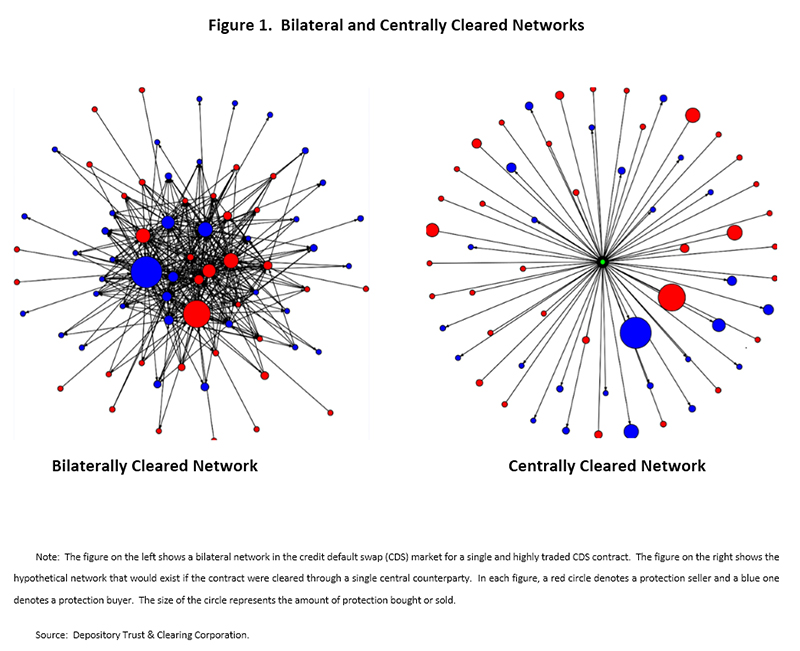
Case number two: Fed Governor Jerome Powell. I was particularly pleased to see that Powell recognizes that the picture that was repeatedly used to sell the benefits of clearing is highly misleading because it fails to take a system-wide approach: I criticized this picture in presentations as early as 2011, and also in some published work. Though I would say that Powell still omits many of the other connections between major financial institutions in a cleared world.

More from Powell:

I am a believer in the potential benefits of central clearing under the right circumstances. But central clearing is not a panacea. Charts similar to that in Figure 1 are often used to illustrate the netting of exposures and simplification that central clearing can bring to an OTC market. The tangled and highly opaque picture of a purely bilateral market is replaced by the neat hub-and-spoke network in which a CCP is buyer to every seller, and seller to every buyer, allowing netting and greater transparency for participants and regulators alike. Of course, reality is not so elegant, as Figure 2 illustrates. There are multiple CCPs, even within product classes, and major dealers act as clearing members across a broad network of CCPs. Clearing members also perform a range of services for CCPs, including custody, liquidity provision, and settlement. By design, increased central clearing will concentrate risks in CCPs; it is essential that, as these risks accumulate, the CCPs build up their ability to manage them. It is often noted that CCPs made it through the recent financial crisis without direct government assistance. But many of their major clearing members did receive such assistance. CCPs must now plan for a world in which these large firms will fail and be resolved without government support.

. . . .

All of these efforts are directly aimed at strengthening FMIs. But the strength and resilience of a CCP ultimately depends on the strength and resilience of its clearing members. I’d now like to shift focus to the relationship between these market utilities and the institutions that use them.

Barring an operational event, CCPs only face credit or liquidity risk when one of their members fails to make a payment when due. Thus, one effective way to make a CCP safer is to make its members safer. In that sense, the post-crisis reforms that have greatly strengthened our largest and most systemically important banking institutions have directly benefitted CCPs and other FMIs.

This last part, of course, raises the obvious question: would measures to “[strengthen] our largest and most systemically important banking institutions” been sufficient to address macro prudential concerns about OTC derivatives, making unnecessary clearing mandates?

But the biggest, and most surprising case is the BIS:

Clearing though a CCP creates a centralised network of trading exposures. Conceptually, this may influence systemic risk in two main ways. First, central clearing may affect the propagation of an (exogenous) shock through domino effects: the losses deriving from a counterparty default could trigger further defaults and spread the shock through the system. Second, central clearing, and the associated risk management practices, may affect the likelihood and impact of endogenous “run and deleveraging” mechanisms even in the absence of an initial default. While, in practice, both mechanisms may interact, considering them separately helps us to understand possible changes in the nature of systemic risk.

. . .

For example, the size of a shock would matter for systemic risk to the extent that defaults inflict a liquidity shortage on a CCP. If one or more clearing members fail to meet their clearing obligations, the CCP itself must provide liquidity in order to make timely payments to the original trading counterparties. The CCP’s own liquid assets and backup liquidity lines made available by banks may provide effective insurance against liquidity shocks resulting from the difficulties of one or a few clearing members. But they can hardly provide protection in the event of a systemic shock, when a large number of clearing participants – potentially including the providers of liquidity lines – become liquidity-constrained, thereby triggering domino effects.

. . . .

A centralised structure of trading exposures may also affect the likelihood and nature of endogenous shocks in the form of forced deleveraging, fire sales and runs. The critical issue in this regard is the interaction between CCPs’ risk management practices and those of clearing participants. On the one hand, if stringent risk management by a CCP replaces lax counterparty risk management in bilateral markets, central clearing would tend to reduce the risk of such procyclical behaviour. On the other hand, an unexpected tightening of CCP risk management could still lead to liquidity pressures on participants that could ultimately trigger fire sales and a self-reinforcing deleveraging (Morris and Shin (2008)).

. . . .

Turning to the risk of endogenous deleveraging, the assessment of the impact of post-crisis trends is similarly ambiguous. The fact that an increasing share of trading positions is subject to daily variation margin payments has arguably reduced the risk that counterparties are confronted with sudden big losses, as was for instance the case with AIG. However, the shift towards the centralised risk management of trading positions, including collateralisation and high-frequency margining, is also likely to affect market-wide liquidity dynamics. For example, extreme price movements in cleared financial instruments could result in large variations in the exposure of clearing members to the CCPs and therefore in the need for some of them to make correspondingly large variation margin payments. Such payments can be large, even if margin requirements remain unchanged. But they may be exacerbated if the CCP increases initial margins and/or tightens collateral standards in the face of unusually large price movements.


I made all of these points, or closely related ones, going back as far as 2008-2009, at times to the disdain of the BIS. One example occurred when made a presentation at the Notre Dame Financial Regulation Conference in May, 2011, where two BIS economists said I was being alarmist. Another was at a conference sponsored by the BofE, ECB, and Banque de France in September, 2013.

So it’s nice to see them come to their senses.

The last point in what I quoted is particularly amazing. One BIS position that I have ridiculed was that variation margin flows created no liquidity demands because they were zero sum: every dollar paid by the loser is received by the winner, allowing the collateral to be recycled. Presumably by having the winners lend to the losers. Even overlooking the operational impossibilities of this, what’s the point of variation margin (which reduces credit exposure in derivatives contracts) if variation margins are funded by credit? And there are operational issues. Liquidity is needed precisely because payments are not frictionlessly and instantaneously recycled. Timing mismatches create a need for liquidity and credit.

So it’s particularly nice to see the BIS get beyond its risible dismissal of the possibility that variation margins can create systemic risks via a liquidity channel, and recognize that this is a serious issue. Because it is. The most important risk in clearing, in my opinion, and one that becomes even more important when regulators take other measures to protect CCPs.

All in all, it’s good to see regulators starting to grapple with the potential systemic risks inherent in clearing. It is better than continued cheer-leading, as was the norm from 2009 until very recently.

But that said, the time to start worrying about potential major design flaws in an aircraft isn’t when it is just reaching cruising altitude. Takeoffs are optional, landings are not. It’s best to make sure that a safe landing, rather than a crash, is highly likely before taxiing down the runway. In their wisdom, legislators and regulators in a hurry didn’t do that. They rushed a new, complex, and untested design into the air. Let’s hope that the newfound awareness of the potential risks allows them to make in-flight repairs and adjustments that will make a crash unlikely.


December 1, 2015

The Red Queen’s Race: Financial Regulation Edition

Filed under: Clearing,Derivatives,Economics,Financial crisis,Regulation — The Professor @ 8:44 pm

Well over four years ago, I raised concerns about clearing mandates leading to the rise of “collateral transformation” whereby those needing high-quality assets to pledge as collateral against derivatives trades would obtain them via repos collateralized by low-quality assets. I argued that these transactions were inherently fragile, and could go pear shaped during period of market stress.

If this were the only problem that post-crisis regulations created, how lucky we would be! Yesterday, the FT ran a nice (meaning scary) piece about other regulation-related driven spurts in securities lending that are collateral transformation on steroids.

One big driver is the Liquidity Coverage Ratio, which requires banks to hold one month’s stress period liquidity needs in liquid assets like government bonds. Rather than sell other less liquid assets to raise the cash to buy Treasuries, Gilts, Bunds, etc., banks are posting their less liquid assets (including equities) as collateral against borrowing of government securities.

Think of how this could work in a crisis. Yes, a bank can sell the borrowed guvvies to raise cash to meet deposit outflows or other cash needs in a crisis. But it borrowed these securities, so it has to buy them back, eventually. Perhaps its liquidity crisis will have passed before the loan matures, but perhaps not. What then, genius? Liquidity crisis deferred, not necessarily prevented.

There are other concerns. The lender of the government bond is likely to haircut the collateral more steeply during crisis periods, meaning that the stressed bank is going to have to come up with more collateral to support its loan precisely when it can least afford to do so. The cyclicality of the collateral mechanism is a concern, and it can create all sorts of vicious cycles that have spillovers throughout the financial system.

Furthermore, the article notes that asset managers like BlackRock are the major securities lenders. They lend out bonds purchased to back government bond ETFs, and take other securities as collateral. That is, the asset manager is engaged in a financial transformation in which there can be a mismatch between the assets underlying the ETF and its liabilities: swapping government bonds for equity (or other assets) creates such a mismatch. What happens if the ETF sponsor is it by a wave of redemptions–especially if the redemptions occur because investors become concerned because the value of the collateral the sponsor has collected has fallen, and may be substantially below the value of the assets lent out (which is what the fund is intended to track)? One possibility is fire sales of the collateral and “fire purchases” of the assets the fund has lent out. A more likely outcome is that this is the kind of event which will cause the fund to demand significantly more collateral from the security borrower, setting off the vicious cycles described above.

Oh joy.

The article states that another reason for the rise in securities lending is that banks get better capital treatment on the borrowed securities than the securities posted as collateral. If this is true, it is totally nuts. The borrowed security is not an asset to the bank: the assets posted as collateral for the loan are. The borrower has the asset in his hot little hands, but has an obligation to give it back: these things offset. At the end of the day, the bank still has the other assets posted as collateral. If capital regs treat the borrowed bond as an asset, and don’t treat the securities posted as collateral as an asset, and reduce risk weighted assets (and hence capital requirements) as a result, the regulations are even dumber than I had thought possible.

That is really saying something.

The third reason for the rise in securities lending is my old favorite, collateral transformation to obtain CCP-eligible collateral. This part of the article made me laugh:

There is a third plus, too, as another facet of post-crisis regulation gains momentum. With so much derivatives trading moving to central counterparty clearing, there is increasing demand for high quality assets to be used as collateral. And for that, government bonds — even borrowed ones — avoid punitive haircuts imposed on some equities.

I laugh because in a collateral transformation trade, there is a potentially punitive haircut on the equities (or whatever) posted in the collateral transformation trade.

Whenever I see things like this I keep coming back to the story about the Indian village that was infested by mice, so it brought in cats which then multiplied and became such pests that they brought in dogs to run off the cats, but then the dogs became such a problem that they brought in elephants to scare away the dogs, and when the elephants started wrecking the place they reintroduced the mice to scare away the elephants.

Things like the LCR and clearing mandates were introduced to solve one set of problems (or perceived problems) inherent in the financial transformations that banks provide. But these regulations have led to the proliferation of other kinds of transformations that are problematic in their own ways. These new transformations create new, potentially fragile, interconnections. They create new counterparty and liquidity risks even as they mitigate some old ones.

Or to invoke another metaphor, this is like the Red Queen, running at breakneck speed to stay in the same place:

“Well, in our country,” said Alice, still panting a little, “you’d generally get to somewhere else—if you run very fast for a long time, as we’ve been doing.”

“A slow sort of country!” said the Queen. “Now, here, you see, it takes all the running you can do, to keep in the same place. If you want to get somewhere else, you must run at least twice as fast as that!”

Yes. Very much like that indeed. Perhaps we haven’t quite stayed in one place, but the running over the past 5 plus years has not moved us nearly as far as the Frankendodd and EMIR and MiFID II pom-pom squad claim.  Risks have been shifted and transformed, rather than eliminated. In the attempt to banish the devil we knew, we’ve teamed up with some lesser-known demons. Sadly, we are likely to become much better acquainted, sooner or later.

November 12, 2015

Big Sister on the Warpath Against Commodity Derivatives

Filed under: Commodities,Derivatives,Economics,Financial crisis,Politics,Regulation — The Professor @ 3:27 pm

Elizabeth Warren’s panties were in a bunch the other night because of an ad that portrayed her as a “Commie dictator” (her description). (Liz’s panties always seem to be in a bunch, but they were bunchier than usual on Tuesday.) The ad, which blasts Warren’s anti-Constitutional monstrosity, the Consumer Financial Protection Bureau is actually somewhat amusing. Warren’s image appears in the background on a Big Brother-ish–or would that be Big Sister-ish?–banner.

I agree with Warren. She is not a  Commie dictator. She is a wannabe Commie dictator.

Her anti-market efforts are not limited to birthing and defending the CFPB. She is also a virulent critic of derivatives, especially when banks trade them. Pre-commercial, her ire this week was focused on the repeal of the swaps pushout rule, the brainchild (and I use that term very loosely) of fortunately ex-Senator Blanch Lincoln (D-for-dim, Arkansas). Warren fulminated that as a result of the repeal, banks were able to keep $10 trillion notional in particularly risky swaps in their deposit-taking units, rather than spinning them off into separately capitalized subsidiaries that cannot benefit from deposit insurance.

This rule was targeted at swaps that were deemed especially risky, including most notably, commodity swaps. But commodity swaps, and many equity derivatives, are not especially risky. Risk depends on whether the positions are hedged or hedgeable, the creditworthiness of the counterparty, and the credit support (e.g., collateral) in the transactions. And notional principle is certainly not a measure of how much risk is in a derivatives book. Therefore, putting commodity swaps, equity swaps, etc., in a ghetto does not make economic sense. There is no reliable mapping between the underlying of a derivative and the risk it creates.

Furthermore, risk has to be evaluated on a portfolio basis. Segmenting derivatives books can reduce diversification benefits, and crucially, breaks netting sets. Breaking netting sets tends to increase counterparty risk, or require more costly collateral to keep counterparty risk the same. (As I’ve written many times, the systemic effects of netting and collateral are ambiguous because of their main effect is redistributive. But if you are concerned about the counterparty risks that banks face, you should prefer more netting to less.)

Frankendodd is chock-full o’ stupid and dangerous, but the swaps push out was in the running for the title of dumbest and most dangerous. It makes no economic sense as a way of achieving the purported purpose of reducing the risks that banks pose to taxpayers. But Warren and other progressives have made it a litmus test for determining which side you are on, that of the angels, or the banksters? This is a false choice.

But expect Big Sister Liz to remain on the warpath against derivatives. Which is exactly why the 1984-esque portrayal of her in that commercial is spot on.


« Previous Page — Next Page »

Powered by WordPress